Remembrance Sunday 2015: Branse Burbridge

When I was an undergraduate, I worshipped at St Aldate’s Church in Oxford. One member of the pastoral team was a Reader whose name was Branse Burbridge. It’s one of those names that sticks with you! His wife was Barbara. She was also a member of the pastoral team, so between them – Branse and Barbara Burbridge – they were a bit of a tongue-twister!

Branse led worship and preached at services, but what I remember about him is the way he read scripture. I learned that if he was reading in church he would study several different translations of the passage and put together his own version. He had worked for Scripture Union, as schools’ secretary. He put so much in to his preparation that, in church, instead of reading the text from the page, he brought it to life, like an actor delivering a monologue. His son, Paul Burbridge, is part of the Riding Lights Theatre Company, so the acting gene was obviously passed on from his father!

We also knew that Branse had ‘been something in the war’. All I really knew at the time was that on Remembrance Sunday, Branse wore his medals on his Reader’s scarf. It didn’t mean a lot to me. I have since discovered that:

Wing Commander Bransome Arthur “Branse” Burbridge DSO & Bar, DFC & Bar (born 4 February 1921) is a former Royal Air Force (RAF) night fighter pilot and flying ace—a pilot credited with at least five enemy aircraft destroyed—who holds the Allied record of 21 aerial victories achieved at night during the Second World War. Burbridge is the most successful British ace still living.

Branse, the rather quiet, modest, gentle, artistic man that I knew was a genuine war hero. A flying ace, who holds the record for the most kills achieved by a night fighter. He and his navigator, Squadron Leader Bill Skelton (who later became a priest in the Church of England), were known as the ‘night hawk partners’. Bill and Branse used to have theological discussions while they were flying above the clouds at 300MPH.

I also learned that Branse was brought up in a Christian household – his father was also a preacher – and that the family were pacifists. In September 1939, because of his strong Christian beliefs, Branse registered himself as a conscientious objector.

As the war progressed, he changed his views. He had believed that as a Christian, it was not right to take another person’s life. Jesus tells us that we are to love, not just those who love us, but our neighbour, whoever that might be, and that our enemy is also a neighbour whom we are to love. Branse became convinced that, although it was not right to take someone’s life, the war meant that people were dying and that he should do what he could to prevent the deaths of others. In 1941, at the age of just 20, he joined the RAF, where he became the night fighter pilot that I have described.

He came to believe that shooting down an enemy plane, his aim was not to kill the pilot but to prevent that plane from killing anyone else. He is quoted as saying:

“I always tried to aim for the wings of enemy aircraft and not the cockpit. I never wanted to kill anyone.”

Branse remained the gentle, loving, Christian man, who came to believe that it was his Christian duty to help bring the war to an end. When asked how he had the courage to do what he did, he said, “Well, someone had to do it!”

The next time I heard about Branse was a few years ago when a story about him made the papers.

In February 2013 Burbridge’s family reported that he is suffering from Alzheimer’s disease and they were considering selling his medals and wartime memorabilia to fund his private care home. On 25 March 2013, Burbridge’s medals fetched £155,000 at auction.

A gentle Christian man, a bone fide war hero, now with Alzheimer’s and needing care, which he and his family did not have the resources to provide, in the way they felt he needed and deserved.

On Remembrance Sunday, we rightly name those who have died in the service of their country and in the defence of our freedom. We also remember those who survived. They too have paid a price for the freedom we enjoy.

Peace on Earth?

To being with a question: Did Jesus come to bring peace on earth?

Yes, of course! Right from the beginning, from the Christmas story, we hear the angels sing:

‘Glory to God in the highest heaven,
and on earth peace among those whom he favours!’ (Luke 2:14)

(Not everyone then? Just those whom God favours? Maybe it will turn out that God favours everyone!)

Or, if you want to go back earlier and pick up the verse in Isaiah as a pointer to who Jesus is, he is the Prince of Peace (Isaiah 9:6)

Jesus, Prince of Peace

Jesus’ life and ministry are all about bringing peace, aren’t they?

We see it when Jesus meets individuals in need:

And he said to the woman, ‘Your faith has saved you; go in peace.’ (Luke 7:50)

And in his preaching:

‘Blessed are the peacemakers, for they will be called children of God. (Matthew .9)

When he sends the disciples out to preach:

Whatever house you enter, first say, “Peace to this house!” (Luke 10:5)

Jesus weeps over his city, Jerusalem, and with it, the world:

‘If you, even you, had only recognized on this day the things that make for peace! But now they are hidden from your eyes. (Luke 19.42)

And his parting gift to those who put their trust in him is peace:

‘Peace I leave with you; my peace I give to you. I do not give to you as the world gives. Do not let your hearts be troubled, and do not let them be afraid.’ (John 14.27)

Not Peace, But Division

And yet, in today’s Gospel we read that Jesus says:

Do you think that I have come to bring peace to the earth?
No, I tell you, but rather division! (Luke 12.51)

In Matthew’s gospel (Mt 10:34), it’s a sword that Jesus has come to bring, not peace. So what’s that all about then?

When Mary and Joseph take their child into the Temple, they meet the old man, Simeon:

And the child’s father and mother were amazed at what was being said about him. Then Simeon blessed them and said to his mother Mary, ‘This child is destined for the falling and the rising of many in Israel, and to be a sign that will be opposed so that the inner thoughts of many will be revealed—and a sword will pierce your own soul too.’ (Luke 2:33-35)

Mary’s son, the prince of peace, for all that his life will be an expression of peace, love and compassion, will know that you can’t force peace on others. Jesus, the man of peace is destined to be rejected by those in power, and that will break his mother’s heart. And Jesus will warn that those who follow him will also experience that pain. Families will be divided as some say yes to God’s offer and others reject it.

Peace With God

Peace? Yes – we can have peace with God.

Therefore, since we are justified by faith,
we have peace with God through our Lord Jesus Christ (Romans 5:1)

Peace With Others

We are to strive for peace with others.

If it is possible, so far as it depends on you, live peaceably with all. (Romans 12.18)

I love that “so far as it depends on you”. You can do no more!

Peace At The Last

We can look forward to the peace that is promised.

But to have a peaceful life in this world? Given the way the world is, how can anyone be comfortable? We dare not make peace with the world in which we live. Ultimately, peace belongs to the kingdom which is to come.

As Elvis put it so memorably, one day

There will be peace in the valley for me, for me

Or, in the words of John Henry Newman:

May He support us all the day long, till the shades lengthen, and the evening comes, and the busy world is hushed, and the fever of life is over, and our work is done! Then in His mercy may He give us safe lodging, and a holy rest,
and peace at the last!

Wedding Feedback…

Feedback received from a couple after their wedding:

Absolutely perfect wedding service at St Matthews Stretton. Our vicar was lighthearted and funny as well as very professional. The service was just the right length and we are very grateful to the choir, bell ringers, vicar and anyone else involved who helped everything run so smoothly. Also it’s worth mentioning that we had many wedding guests tell us that it was the best church wedding service they had ever been to. Thoroughly enjoyed by all. Thank you.

Do You See This Woman?

Luke 7.36–end

Jesus asks a good question. Let me rephrase that: does Jesus ask a good question? (You’ll have guessed that I think he does.) Here, the question addressed to a respectable religious man named Simon, is:

Do you see this woman?

How could he not have seen her? She’s in his house! And behaving… Like that! Such a notorious woman, a well-known ‘sinner’. How could he not have seen her? A woman like that! (We are never told what kind of sinner she is. But we can guess. Her reputation goes before her.)

Perhaps we wonder how a woman like that comes to be in the house of Simon the Pharisee. ‘Mr Respectable’ certainly didn’t invite her. We’re so used to living behind locked doors, keeping the world out, that we can’t imagine a world where, if you invite a celebrity to dinner, the whole street turns up.

And what does she think she is doing there? It turns out, that although the respectable, religious world has rejected her – they know what sort of woman she is! – Jesus hasn’t. And Jesus, through his actions, models what God is like.

Simon, the respectable religious man, thinks, “If Jesus were a prophet, he would know what sort of woman this is, and have nothing to do with her”. And here she is, bathing Jesus’ feet with her tears, drying them with her hair. Kissing his feet! Showing her gratitude and love in the only way she knows how, through intimate, tender touch.

Simon, do you see this woman? Simon hasn’t seen this woman. He has only see what sort of woman she is. Jesus has seen this woman: a unique individual, created in the image of God.

And so Jesus tells this story about the two debtors. Neither of them is ever going to pay back what they owe, but the banker lets both of them off! Given that one owed a large sum of money and the other, a ginormous sum of money, who is going to be more grateful? (A: The one who is let off the larger amount.)

Simon, the respectable religious man, presumably feels that God is jolly lucky to have him on board. This woman (and sadly we are never told her name) feels simply overwhelmed that God, unlike so many others, has not rejected her. That’s what Jesus shows in the way in which he accepts her love.

Jesus tells her that her sins are forgiven, that her faith has saved her; that she can go in peace. Who is this that even forgives sins? Jesus is demonstrating God’s love, welcome and acceptance.

The photographer, at ‘the wedding of the year’, is taking pictures of guests as they arrive in church. The bride’s mother appears in all her glory. “Young man”, she says to the photographer. “I hope that you will do me justice!” “What you need”, says the photographer under his breath, is not justice, but mercy.”

How do you approach God today? Demanding that he do you justice? (Be careful!) Or simply needing his mercy? (I know which I need!)

The Times They Are A-Changin’!

I recently read an article by a Dr Bill Tenny-Brittian called ‘Understanding the role of your pastor‘. Although it was written in an American context, some of the author’s observations made sense to me. He describes the 1950s as the ‘golden years’ of the church. ‘Back then,’ he says, ‘”everyone” went to church.’ Of course, that was never really true, but in the post-war era most people either went to church or felt they should. (I occasionally come across this now: I can bump into someone in the supermarket and their first words to me are, “I’m sorry I’ve not been to church recently”.)

Back in those days, church offered just one strand of worship. In the Church of England it was always from the Book of Common Prayer. Of course, there were ‘High church’ and ‘Low church’ ways of doing it, but once you had chosen your style you stuck with it. Children were offered Sunday School but there was no catering to different age groups when it came to worship in church.

Back in the ’50s, the pastor’s primary job was to ensure everyone in the church was well cared for.

The pastor or vicar had to make sure that everything ticked along and that everyone was happy. The vicar spent his time (it was always ‘him’ in those days) in his study making sure things ran smoothly (and writing sermons), or attending meetings to make sure things were going well. The rest of his time was spent visiting church members in hospitals, nursing homes or in their own homes.

No one worried about church growth back then. No one was worrying about growing their church because in the 1950s the members pretty much took care of church growth.

Families came to church and stayed in church. “The church was on autopilot. The pastor took care of the flock and the flock multiplied biologically.” The author then says this:

In many (most) churches, if 1950 ever comes back the congregation is ready!

But being ready for the 1950s is no help for the situation in which we now find ourselves. So what happened? In a word, the 1960s! That decade was a time of enormous change. As Bob Dylan put it in 1963, ‘The Times They Are A-Changin’. Dylan wrote on behalf of a generation that no longer followed in the footsteps of their parents and grandparents. ‘Mothers and fathers’ didn’t understand their children. They should get out of the way, he sang.

For generations, parents have been used to their children going through a rebellious phase, including not going to church. They have assumed that their children would grow out of it and find their way back. But that has not happened. Today’s children have been brought up by parents (and grandparents) who have little or no experience of church. And, no, they don’t feel guilty about it! Going to church is no longer felt to be a duty or something that ‘most people’ do. For many, church is a leisure activity for those who like that sort of thing, an optional extra that gets squeezed out by shopping, sport or house-cleaning.

And that’s alright! I wouldn’t want to go back to an era when people went to church because they felt they had to, because it was the respectable thing to do. I want people to come to church because it is what they have chosen to do. Because they feel welcomed, accepted and loved. Because they know their need of God. Because they want to be equipped to serve God in the week ahead.

Dr Tenny-Brittian’s view is that the pastor’s role today is not simply to look after church people, keeping them happy. He says, and I agree, that the pastor’s role is biblically rooted in Ephesians 4:11-13:

It was he who gave some to be apostles, some to be prophets, some to be evangelists, and some to be pastors and teachers, to prepare God’s people for works of service, so that the body of Christ may be built up until we all reach unity in the faith and in the knowledge of the Son of God and become mature, attaining to the whole measure of the fullness of Christ. (Ephesians 4:11–13)

He writes:

Notice the pastor’s primary role is to prepare the church members to do works of service, that is, the ministry of the church. It’s the church members’ job to do most of the things the 1950s pastor took care of. It’s the pastor’s job to recruit, train, deploy, and coach other church leaders to do all those ministries.

Of course, that doesn’t mean I will give up visiting church members at home or in hospital: that’s still an important part of my role. But we need to get away from the idea that the vicar’s job is to keep church members happy! The vicar’s job is to equip the church for two main purposes:

    Taking care of one another and

    Reaching out to the wider community.

Which is not to say that I won’t be doing those things as well, but think how much more we could do if the whole church took responsibility for pastoral care and outreach! An important part of my job, therefore, is to equip church people to do the work of the church!

What do you think?
Alan

The Golden Rule (Luke 6:27-38)

The ‘Golden Rule’ – “Do to others as you would have them do to you” – has been around in some form or other in different cultures over many centuries. It was around before Jesus used it, although before Jesus, it tended to be stated in a negative form: “Don’t do to others what you wouldn’t want them to do to you”. In this form, it was about limiting the harm we do. Like the Old Testament injunction, “An eye for an eye, a tooth for a tooth”, which was about limiting revenge so that it did not escalate. But we still end up with a lot of eyeless, toothless people!

Or the lawyer who, being told by Jesus to love his neighbour, asks, ‘Well, who is my neighbour?’ He’s trying to limit his obligations by closely defining those to whom he owes his love. Jesus turns that upside down: not, Who is my neighbour? Buy, Who isn’t?! Is there anyone I can’t be a neighbour to, if I choose? And Jesus gives him the Parable of The Good Samaritan to illustrate that anyone can be a good neighbour to anyone if they choose, including the people they don’t naturally get on with or relate to.

And that’s the point. If we love those who love us, it makes the world go round smoothly, but only because we have a reciprocal arrangement with those around us: You scratch my back and I’ll scratch yours. We’ve evolved to do favours for one another: I’ll let a car in front of me in the queue for Runcorn Bridge, because, I’d expect someone else to do the same for me. That’s how the world works. I will do something for you in the expectation that you’ll do something for me at some point down the line. According to the film, The Godfather, that’s how the Mafia works: I’ll do you a favour. And at some point in the future, I’ll call that favour in. You’ll have to do it, because you are indebted to me.

Jesus says, Imagine doing something for someone who can never repay you! Just doing it – being kind to someone who can never return the favour:

Love your enemies, do good to those who hate you, bless those who curse you, pray for those who abuse you.

Anyone can love their neighbour, if they are allowed to choose who their neighbour is – the nice people who are like us – even sinners do that. But Jesus says we can love our enemy.

How can we love our enemy? Because love isn’t a deal we make with one another: it’s the undeserved, unrewarded commitment to make someone else’s life better, to want the best for someone else, regardless of whether that can work for our benefit to. What does that look like? It looks like Jesus, forgiving his killers from the Cross. It is God being merciful to ungrateful wretches like you and me.

It’s called grace. Once we grasp that, or begin to grasp that, to know that we are loved, even though we don’t deserve it, we can start to love one another, including those who don’t deserve it.

There’s a lot more that needs to be said about the verses in this passage: it’s not an abuser’s charter; offering the other cheek to someone who slaps you is about defiant but non-violent resistance; as is giving your shirt to someone who has taken your coat, because it leaves you naked and shames them, not you. Perhaps giving money to a beggar on the street may not be the most loving thing to do. But the kingdom principle is clear:

God loves sinners. He loves you! And he expects us to love one another, including, and especially, those who can never love us back.

What’s the Point of The Book of Common Prayer?

Daily Mail columnist Quentin Letts has been presenting a series on BBC Radio 4 looking at various British institutions and asking, “What’s the point?” (Wags on Twitter and other social media have been quick to respond: what’s the point of Quentin Letts? Although it’s his review of Benedict Cumberbatch’s Hamlet that got Letts trending on Twitter.) This week he asked, What’s the point of the Book of Common Prayer? The programme started with the observation that most churches now use contemporary forms of worship, and asked “why do a small minority of people choose to cling to a service that was written around the 1550s?” We then heard a clip of a plummy-voiced vicar intoning the words of Evening Prayer:

O Lord, open Thou our lips

And the choir’s response:

And our mouth shall show forth thy praise.

These words and the way in which they are sung will be very familiar to some; and completely alien to others. But is the Book of Common Prayer simply a refuge for those who struggle with the modern world? Or does the BCP’s ‘quiet piety’ have something to offer the contemporary soul?

The BBC’s favourite vicar, the Revd Richard Coles, who describes himself as an advocate for the BCP (or parts of it, anyway), pointed out (on Twitter) the programme’s first faux pas. Letts describes the Prayer Book as the Church of England’s ‘premier text’. It isn’t. The Bible is the Church of England’s premier text. And part of the reason that people love the BCP (as Coles does) is that it is shot through with biblical texts, in language that is familiar to those who were brought up on the King James Version.
As many have acknowledged, the English language owes much to the BCP, the Bible and Shakespeare. Letts points out that “the literati care about the BCP”; it is loved by poets and writers. As an example, he spoke to James Runcie, novelist and director, and the son of a former Archbishop of Canterbury, who was brought up on the language and piety of the BCP. He said the point of the BCP was that you can’t understand English literature without it, alongside the Bible and Shakespeare. Runcie said that if you had those, and the music of Bach – and, as an afterthought, food – you didn’t need much else. (Although he also confessed he never felt that he was quite as sinful as the BCP seemed to assume). Someone from Magdalen College School, Oxford, said how their children valued the BCP prayers they were taught as part of a reading competition. They were not frightened by the language of the BCP as they learn it alongside Shakespeare.

In my view, Letts’s case is surely weakened when the people he wheels in to support the BCP are such establishment figures as the son of a former archbishop of Canterbury and a teacher at an exclusive independent school in Oxford.

Also in Oxford, the programme took us to the place where Archbishop Thomas Cranmer, writer and compiler of the original BCP, and a leading light in the Protestant Reformation, was burned at the stake. Cranmer was a crafter of great prose, we were told, which has borne the repetition of centuries. As well as that, and despite his forced recantation, Cranmer was a convinced Protestant, hence his martyr’s death. Whereas the first Prayer Book, of 1549, was a conservative reformation of the church’s worship, retaining catholic features, the 1552 revision was “aggressively protestant”. A century later, following the Restoration of the Monarchy, the Prayer Book, which had been abandoned by Oliver Cromwell, was revised and published in the 1662 form which remains in use to this day.

Diarmaid Macculloch, who has written a biography of Cranmer, was asked what the point of the Book of Common Prayer was. He replied

The language is one of the points.

He said that Evening Prayer from the BCP, especially supported by the musical tradition of the Church of England, remains unsurpassed. The BCP also represents a link to the past which is part of this country’s story.

Which brings me to a key question of my own: given that we were started by a Galilean Jewish Rabbi, when did it become the church’s responsibility to promote English language, culture and history? The church is not called upon to act as an advocate for Shakespeare or choral music. Why should it promote ‘theme park England’?

This is the world of which John Major spoke:

Fifty years on from now, Britain will still be the country of long shadows on cricket grounds, warm beer, invincible green suburbs, dog lovers and pools fillers and, as George Orwell said, ‘Old maids bicycling to holy communion through the morning mist’ and, if we get our way, Shakespeare will still be read even in school.

I’m not a cricket fan. I prefer my beer cold. I like cities rather than suburbs. I don’t have a pet and wouldn’t know how to fill in a pools coupon. And I thought that Shakespeare was a dramatist whose work was to be performed rather than read. I am English and wouldn’t want to live anywhere else. But I suspect that nostalgia is a deadly virus that should be kept out of churches.

The Revd Chris Moore, a vicar in rural Herefordshire, was asked about the use of the BCP in his parishes. Parishioners see BCP services as offering continuity with the history of the parish but also with their own childhood and the story of their own families. These are the prayers of our forebears and the prayers of place. He saw the value of BCP tradition in his rural, settled community (with its sparse population) and particularly in nursing homes when ministering to people with dementia, and even those who were comatose. Prayer Book words, he said, made a deep connection with people for whom they were part of their tradition. I understand that. But I don’t see it as an argument in favour of using the BCP at our main services. In a previous parish we had an old gentleman who occasionally used to visit his daughter somewhere rural in the south. He loved their early morning BCP communion services: they were exactly as he remembered them when he was a child. I’m not convinced that the role of church is to give people an opportunity to escape to the simpler world they knew as a child. I think our resources are needed more to equip people as they try to navigate the complexities of the world as it is today.

Letts saw the BCP as empowering people. Modern liturgies gave more power to clergy to control what was said in church, as they get to choose the words, unlike the BCP which strictly prescribes what may be said on any occasion. All very well in the days when clergy were barely literate and in a period of history when the struggles were as much political as religious, so the opinions of clergy had to be controlled by the State as much as by the Church.

The Revd Canon Giles Fraser, one of the more turbulent priests in the Church of England today, described the BCP as a “lightning conductor for discontent in the parish”. Those who dislike any sort of change in church life tend to gather around the BCP. They describe themselves as ‘traditionalist’. But what they want, he argued, was the 1950s, not the 1550s. The BCP was part of their “roar against modernity”. It’s also the atheist’s favourite expression of religion, he said, because you can love it for its language, while disavowing its content. He dislikes the ‘fetishisation’ of C16th language which some BCP supporters seem to love.

“It becomes a sort of an idol.”

He also said, that he didn’t like “the grovelling”. The BCP depicts God as a C16th Monarch to whom you have to grovel as a miserable worthless worm. (Just look at way BCP Evensong begins, how it gets us to approach God!) So, the BCP suits those who find change difficult. Fraser argues they need to grow out of their fear of change.

At the other end of the spectrum we find Messy Church – informal worship for all ages and a growing phenomenon reaching out to those who don’t come to our normal Sunday services. Does Messy Church even have a liturgy, he asked? What is liturgy, anyway?, his interviewee replied. It is how we give shape to our shared worship. Even the most informal ‘messy’ style gathering has a shape: Welcome, prayer, singing, hearing the bible, talking about life and faith, conversation and exploration with hands-on activities. Wasn’t this what Cranmer was doing? Putting the truths of the faith into ways that connect with people. We perhaps forget that what Cranmer did was to put prayer and liturgy into contemporary English language – not that priestly religious Latin that had gone before. If we think that God prefers to be addressed as ‘Thou’ we forget that in the C16th you would address your neighbour and your child as ‘Thou’. ‘Thee’ and ‘Thou’ is not special language that we use when talking to God. It was the vernacular of an earlier age. We no longer address one another as ‘Thou’. Why would we talk to God like that?

Letts then spoke to Geraint Bowen, organist and director of music at Hereford Cathedral. Bowen said that the BCP “governs what we do, as the cathedral choir”. He spoke of the ‘timelessness’ of their routine of daily evensong and matins. There’s no difference between what we do, he said, and what was envisaged in the 1550 BCP. He liked the BCP’s use of the Psalter in daily worship. On the 30th day of each month, we finish working our way through the psalms with Psalm 150, and so the BCP calendar is a great timekeeper. Cathedral worship is attracting more people, including those “not conventionally religious”. The BCP speaks to them, he said. But if cathedral worship is, as was stated, part of the “glory of English culture”, does that mean that the average parish church, with our limited resources, should seek to ape that? Are we not likely to fall short, offering a pale imitation of what people who attend Cathedral evensong crave? Also, in cathedrals, it is often the choir and organist who rule the roost. I don’t think that is healthy, and certainly not in parish churches.

Another Hereford vicar, the Revd Neil Patterson, pointed out that while the BCP is contained in a single, slim book, Common Worship provision occupies a lot more space. You can pop a Prayer Book in your pocket, which you can’t do with Common Worship. That’s fair, but the BCP is hardly comprehensive: no Carol Services, no Harvest Festivals and very little seasonal variation. In fact, what people love about the BCP, its familiarity, is also its greatest weakness. Apart from the psalms and biblical readings, and the collects, almost nothing else changes. There is very little recognition of the changing feel of the church’s seasons, its festivals and times of solemnity. Every Sunday in the BCP is the same as every other! Common Worship’s variety is one of its strengths. And you don’t need to carry all the books with you. You can download an app and read it from your iPad – as I do! Or you can produce local versions with just the material you need for a given occasion or set of occasions. (Do you really need access to the Funeral service while you are at a wedding? Actually, don’t get me started on the BCP funeral service!) Patterson argued that the wealth of Common Worship provision meant that preparing liturgy had become the preserve of the expert – the clergy – whereas anyone can pick up a Prayer Book and find their way around the services. Actually, I doubt if that’s true. I struggle to make my way through a 1662 Communion Service, finding the pages and knowing which bits to use as I fight my way through the homilies and exhortations that don’t really need to be there in the congregational version.

Prince Charles is Patron of the Prayer Book Society. He says that we shouldn’t be surprised if the language of prayer is difficult. The Word of God, he says, is supposed to be a bit over our heads. I don’t agree. The depth of the Bible will go over all of our heads. But there is enough there for the simplest soul, from cradle to grave. I’m sure Cranmer believed that. I think that obscuring the clarity of much of the Bible’s message behind archaic language is a way of hiding ourselves from what the Bible says. (I wish I thought that Prince Charles really wanted to hear the Word of God!)

Cranmer’s aim in producing the BCP was to replace a liturgy which didn’t connect with people and which no longer met the needs of the church, to get away from the clericalism of Latin masses and offices with simple prayers that could be understood by the person in the pew. But the BCP is now as foreign to most of us as the Latin mass.

Quentin Letts loves the BCP. He says that the Prayer Book suits the ‘private protestant prayerfulness’ of some. But he also sees it as chiming with the current mood of Eurosceptic Englishness. That’s all very well: just what we’d expect from a Daily Mail columnist. But not what we would expect from the God of the Bible, who is the God of all, not bound by culture or nationhood. God, after all, is not an Englishman.
Who Are You?

I’ve just heard an interesting story from a couple who are members of the congregation at St Matthew’s. They had a meal with friends who attend the 8:00AM service. While there, they met some other friends who attend the weekly Thursday morning service at St Matthew’s, and then some other friends who come at 10:30AM on Sundays. It turns out that none of these other friends knew each other, despite them all attending the same church! (I thought it was disappointing that they didn’t then bump into some of the 6:30PM congregation and complete the set.)

At St Cross, the situation is simpler: there is just one service on a Sunday, and a monthly midweek communion, which is usually attended by people who also come on Sundays. So, people at St Cross tend to know one another. But across the two parishes we have four or five congregations who may or may not know anyone who worships at another time or in another place.

In one sense, this is not a problem. Many of us are creatures of habit and attend church at a time and place to suit ourselves. Each of the services has its own characteristics and we find a congregation in which we feel at home. There’s nothing new in this: the Bishop of Willesden, Pete Broadbent said in a light-hearted note on growth in the Church Times:

“it always used to be 8 o’clock for the individualists, 10.30 for the families, and 6.30 evensong for the depressives!”

Obviously, we don’t want to categorise all churchgoers in such a simplistic way, but it makes the point that people like choice and the church tries to offer a variety of styles of worship to appeal to the greatest number. Church growth research also suggests that people like a certain amount of predictability from one week to the next. (We decided to lose Matins at St Matthew’s because it was so different from anything else in the 10:30AM slot: people who come to All-age worship one month and then Book of Common Prayer Matins the next – or vice versa – wonder what kind of church we are, contemporary or traditional? If you love one, you might hate the other.)

At a recent PCC morning (yes, your church councillors gave up a Saturday morning to think about how we can encourage the church to grow!) we looked at attendance at St Matthew’s. Like many other churches, we need to face the uncomfortable reality of aging congregations and declining numbers (along with financial worries and the demands of looking after a Grade II listed building). The service registers tell us that All-age worship is the best attended service of the month (particularly on special occasions), followed by our monthly Parish Communion at 10:30AM. Attendance at the other 10:30AM services is sometimes worryingly low. 8:00AM communion is fairly steady, and the 6:30PM congregation consists of a small number of stalwarts, mostly older people, who love their BCP service.

We are trying to develop our styles of worship so that people have confidence in what they come to and what they might invite others to attend. The Christian website Ship of Fools sends a mystery worshipper to drop in on unsuspecting church services to see what they offer to visitors. What would a mystery worshipper make who attended one of our services? Do we have something that we can offer with confidence to a visitor?

But back to the point with which I began: how can we encourage our diverse congregations to become better acquainted? (If we think that’s a good idea!) Of course, there are various social and fundraising events throughout the year – from Walking Day and coach trips, to Christmas Fairs and concerts – which encourage people from each of our congregations and beyond to meet one another. And this month of September sees both churches marking their patronal festivals – Holy Cross day and St Matthew’s day fall a week apart each September (on the 14th and 21st respectively). Both churches are holding special events on the Sunday nearest to encourage church members to meet each other, and to reach out to those on the margins and beyond in our communities. Of course, calling it a ‘patronal festival’ is hardly likely to draw in the crowds, but it gives both churches an opportunity to celebrate what is good about our shared life and our service to our parishes. I hope that you will get involved with one or both of these occasions. Who knows? You may meet someone who is a regular worshipper at your church whom you don’t yet know. Better still, we might meet some parishioners who are not yet regular worshippers but who might just like what they see and consider coming back for more…

St Cross: Come on and Celebrate! Sunday 13th September

4:00PM on Sunday 13th September at St Cross. Open air worship (weather permitting) followed by craft activities and refreshments in church.

St Matthew’s Church Festival Sunday 20th September

10:30AM on Sunday 20th September. All-age worship, followed by refreshments. Hopefully, afternoon tea later in the day (volunteers and cakes required!) and Evensong at 6:30PM.

If you can help with any of these events, please let me know.

Alan Jewell

On Forgiveness

It isn’t every day that forgiveness makes headlines, but it does happen occasionally. This week saw the case of the Bradford teacher, Vincent Uzomah, who was stabbed by a 14-year-old boy in the classroom. The teacher, a practising Christian, says he has forgiven his attacker:

Mr Uzomah said: “I have forgiven this boy… I pray he will make use of the support provided to him to become a changed person.”

We may also remember the story of Gordon Wilson who lost his daughter, Marie, and was himself injured when a bomb planted by the Provisional IRA exploded during Enniskillen’s Remembrance Day parade in 1987. Mr Wilson spoke movingly of his daughter’s last moments and said

“I bear no ill will. I bear no grudge”

He said he had forgiven those who planted the bomb, that he would pray for them, and called for no reprisals from Loyalists. He later went on to meet members of the IRA in order to try to understand their views and motives.

I have no idea how I would react if I found myself in circumstances anything like those described. I still haven’t seen the BBC drama, A Song for Jenny, which tells the story of Julie Nicholson, a vicar whose daughter was killed in the London ‘7/7’ bombings. Ms Nicholson resigned her post and poured her anger and grief into the memoir on which the TV drama is based. She said

“I can’t pretend I have much forgiveness in my heart for the person who took my daughter’s life”

Her response is probably easier to understand.

One of Jesus’ disciples, Peter, asked him

“Lord, if another member of the church sins against me, how often should I forgive?” (Matthew 18:21)

Knowing Jesus to be a generous sort of guy, Peter sets the bar high:

As many as seven times?

he wonders. But he’s way short of the mark.

Jesus said to him, ‘Not seven times, but, I tell you, seventy-seven times.’ (Matthew 18:22)

Jesus tells the story of the king who settles accounts with his officials (Matthew 18:21-35). One of them owes him millions – money he can never pay back. The king orders him and his family, and everything he owns, to be sold, but the official begs for mercy. The king is moved by his plight and sets him free.

In scene two, this same guy comes across one of his fellows who owes him a few quid. He is deaf to the man’s pleas for mercy and has him thrown in debtors’ prison. When news of his behaviour gets back to the king, we’re not surprised that the king’s anger falls on the man who, having been forgiven, refuses to forgive.
Jesus concludes, rather uncomfortably, that’s that what God will do to us if we do not forgive others. It’s a tough lesson, but it links the forgiveness we get with the forgiveness we give. Of course, our forgiveness and God’s are not on the same scale. We’ve racked up millions in debt. God in Christ forgives us our unpayable debt. We then are expected to forgive the trifling sums to which others are indebted to us.
This should come as no surprise; every time we pray the Lord’s Prayer, we pray:

Forgive us our sins
as we forgive those who sin against us.

It’s like the old story of how to catch a monkey. Apparently, you hollow out a coconut through a small hole and put some rice inside. You then tie the coconut to a tree. The monkey comes along, squeezes his hand through the hole in the coconut and grabs the rice. But with a fistful of rice, the monkey’s hand is now too large to pull out of the coconut. The monkey has a choice: let go of what he is holding on to or remain trapped.

To forgive means letting go and getting free.

Welcome?

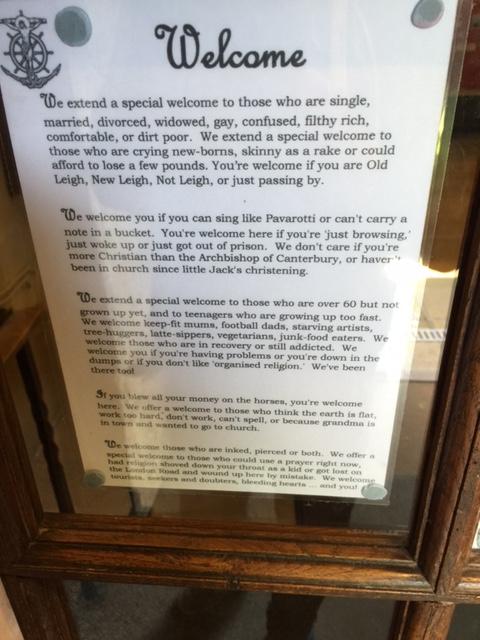
You may have seen on Facebook or elsewhere on the internet a welcome notice which apparently appeared at St Clements Church, Leigh-on-sea, Essex. Please read that, then come back here…
welcome
What did you think? The notice says that the church welcomes everyone, regardless of where we are up to in life or where we have come from. I’m pretty sure that’s what Jesus says: in God’s kingdom, all are welcome. The question is, does the church offer the same welcome?
I remember a story that Adrian Plass tells. (Adrian is a Christian writer and speaker. I’m re-telling it from memory, but the story goes something like this.) He says he was in a supermarket and saw a sign that said “This supermarket would be very pleased if customers reported any spillages to staff.” Around the next aisle he spotted a broken jar of pickle on the floor that had apparently been knocked off one of the shelves. Aha! He thought – here’s my chance to make the supermarket happy! And he duly reported the spillage. The member of staff to whom he reported the spillage looked anything but happy. They rolled their eyes wearily. “I’ll tell the manager”, they said. The manager was called and was told “This customer is complaining about a spillage in the pickle aisle.” Plass didn’t think he was complaining; he thought he was making the supermarket happy; at least, that’s what the sign said.
Adrian Plass’s point is this: the supermarket had a sign but there was no-one actually in the store to make the claim on the sign a reality. He says that church can be like that. We have a sign – from God! – that says that all are welcome. But unless the people in the church make that sign a reality, it amounts to very little.
So, the question to the church is, How good are we at making God’s welcome a reality? Not just to people like us, but to all people? We’ve all heard stories of visitors to churches being told, “You’re sitting in my pew!” Hopefully, we have got past that. We certainly need to! Unless our welcome is genuine, the church dies with us. And none of us wants that to happen.
At the time of writing, I am looking forward to my first experience of Walking Day. It’s been a bit of a struggle making it happen, to be honest. A number of people have worked very hard to make sure that the tradition continues. What is walking day? To be honest, I don’t really know as it’s my first time! But I hope it’s something to do with the church showing to the community that we are alive and well and in business. It’s about showing publically that the church is made up of all sorts of ordinary people, not hiding behind the safe confines of a church building but sharing our joy with whoever. It’s about making God’s welcome known.
In September, we have a couple of opportunities to build on that message of welcome. Both churches have their ‘Patronal Festivals’ in September – a bit like celebrating the churches’ birthdays. Holy Cross Day is on 14th September each year, and St Matthew’s Day is 21st September. We are hoping to mark those days withspecial services on the Sunday nearest – that’s 13th and 20th September respectively. At St Cross we are thinking about an open-air service on the afternoon of Sunday 13th September and at St Matthew’s we plan to use the 10:30AM All-age worship service to mark the celebration. In both cases we are inviting everyone who has a connection of any kind with the church to come and join us.
Whoever you are, I’m sure the church will make you feel welcome!