Evening Worship at St Matthew’s

Thank you to everyone who responded to our questionnaire on evening worship. There were 46 replies, which is pretty good! Of those, 14 people identified themselves as evening worshippers. The questionnaire asked you to state your preference for:

  • the frequency of the service. (Currently, we usually have an evening service on the first, third and fifth Sundays of the month but there was a suggestion that we return to a weekly evening service.)
  • the time at which the service is held. (It had been at 6:30PM but is currently at 4:30PM. The suggestion was made that we consider changing the time in summer and winter.)
  • the style of the service – Book of Common Prayer or contemporary worship.
  • and, lastly, the style of the music – traditional hymns or contemporary songs.

The results of the survey were presented to the PCC at its meeting on 19th May and the PCC made some decisions. Just to be clear, this was not a referendum. It was an exercise in consultation: the vicar and the PCC take responsibility for the services we provide. We sought your views but the final responsibility remains ours. That said, this is where we got to!

The PCC has decided the following:

That, wherever possible, there will be an evening service at St Matthew’s each week.

Obviously, we need to be confident that we have the resources for a weekly service, which includes a minister to lead, a warden or sidesperson to take care of the practicalities, and, where possible, musical resources including an organist and choir.

On occasion, we may join with other churches in the Deanery, or as Bridgewater Churches Together, and that will replace our own evening service; there will also be times when the vicar is holiday and no-one is available to cover, but our usual pattern will be to have weekly evening services.

That the time of the service will change seasonally – 4:30PM in the winter and 6:30PM in the summer.

There isn’t a time that suits everybody, of course, but most people seem happy with this arrangement which allows people to go out for longer on balmy summer afternoons and get home earlier in the darker winter months. We have decided to make the change when the clocks go forward for British Summer Time and back for Greenwich Mean Time. (That’s on the last Sunday of March and the last Sunday of October.)

That evening services will mostly use the forms of worship found in the Book of Common Prayer.

There were some voices raised for more contemporary services, including the suggestion that we put something on that would better suit young people, but the prevailing view was that we mostly use the traditional BCP form of Evening Prayer. In months when there is a fifth Sunday, we will continue to offer a service of Holy Communion, from Common Worship, and on occasion, we will do something different. For example, this year, on the evening of Palm Sunday, we put together an expanded choir to lead a service of music and readings which we called “The Journey into Holy Week”; there might be occasions when we do something more reflective – using material from Taize, Iona or other sources – as we do when we offer Compline in Lent and Advent.

Ideally, the PCC would like the services to be led by the choir each week. I don’t know if this will be possible: the choir has a few very faithful members, to whom we are grateful. It is, however, sometimes a struggle getting enough singers together to lead a successful choral service. But we are going to try! (It may be that there are others who would like to join the choir and learn how to sing the psalms and canticles as we do at evensong.)

That we will mostly use traditional hymns at evening services.

Here the voting was tight, between those who want mostly traditional hymns and those who would prefer a range of traditional and contemporary music. (Nobody wanted ‘mostly contemporary hymns and songs’, so my ideal service – a rock mass, led by a band – isn’t going to be happening just yet! But I live in hope!).

None of the above is set in stone (apart from the vicar’s desire to see rock music in worship) but the PCC has decided that this will be the usual pattern and style of evening worship, starting in July this year, and to be reviewed by Christmas. If you have any observations on our proposals, please let me know.

Morning Services

And that brings me to our morning services… Sadly, in common with many other churches, our Sunday attendance is dropping. Some of the attendance figures for our 10:30AM services are, frankly, quite alarming. We do well on special occasions – Mothering Sunday, Remembrance and so on – and the attendance at All-age Worship (on the third Sunday of the month) is OK. The 10:30AM Communion service (first Sunday of the month) is not doing too badly (although attendance has gone down over the years). That leaves the second and fourth Sundays of the month. Here the figures are shocking and we clearly need to look at what we are doing on those Sundays.

I know that there is a group of worshippers who regret the loss of BCP Matins. I’m also aware that the cessation of Matins was handled badly: I apologise for that. But I don’t think that returning to BCP at 10:30AM is the answer to falling attendance. Before I was appointed to this post, the PCC had decided that all morning services should be contemporary in style and all-age friendly (not just ‘Family Services’ once a month). I believe that that is right and I am committed to that. The PCC has agreed that the evening service will concentrate on meeting the needs of those who value more traditional provision. (There are also communion services at 8:00AM each Sunday and at 10:30AM on Thursdays which cater to those with more traditional tastes.) So, morning services will be our ‘shop window’, the place we are looking to reach out to a wider, younger group of potential churchgoers. But how do we do that?

To be clear, this is not a criticism of those who plan and lead the 10:30AM services. We are doing our best! I suspect that this is partly a modern phenomenon: years ago, regular churchgoers would attend every week, unless sick or away. There were fewer alternatives for Sunday activities. These days the competition is fierce, from shopping to sport, and other commitments which families, in particular, have on Sundays. This means that regular worshippers these days probably expect to come to come to church about once a month. And people pick the Sunday in the month that best suits them. We do have a group of families that come when it is all-age worship, and there are people who prefer to come when it is a communion service. There was a group that came when it was BCP Matins. (There was also a group that stayed away from Matins!) But I don’t think there is a group of people whose preferred option is ‘non-eucharistic, non-all-age’ services, so that is what the PCC needs to look at next. (In my view, there are some terrific resources in Common Worship and elsewhere which can be used to make services which are meaningful, enjoyable and valuable.)

I have to say that I’m not sure that replacing Morning Prayer with either communion or all-age worship is going to be possible. One issue is that you only have one vicar[1] and I have two churches, both of which have services at 10:30AM every Sunday. I believe that some mystics and wizards have mastered the skill of bilocation (being in two places at once), but I have yet to accomplish that. Sadly, we don’t have a curate or assistant priest. St Cross has a communion service twice a month at 10:30AM and so, by default, I am there. Equally, I am usually at St Matthew’s on the first Sunday of the month, and I choose to lead the all-age worship services as that’s the thing I enjoy the most. The trouble then is that St Cross folk wonder why I don’t lead all-age worship there very often. The answer is that it is on the same Sunday as communion at St Matthew’s. I would love to be at both churches for the main morning service each week, with the support of colleagues. I hope that both churches would be happy to have me each week! But our current arrangements do not allow that.

There is also the ‘monthly worshipper’ phenomenon to consider: if we had All-age Worship twice a month, the ‘all-age’ crowd might simply split itself between the two Sundays when this is on offer. Those who prefer communion might not come twice as often if we had two morning communion services.

As we have asked you to think about the music we use in our evening services, it would be helpful to know what hymns you think we should sing in other services. We could then see if our current hymnbooks are adequate, or whether we should consider a new book or the possibility of having words projected on a screen so that we never again have to print a hymn sheet when the person leading the worship chooses hymns and songs that are not in one of our books.

That, then, is the task facing us. The PCC will again use a form of consultation before making a decision about our Sunday morning services. In the meantime, please continue to enjoy what we are doing and tell all your friends: they don’t know what they are missing!

Alan Jewell

[1] On current forecasts there will be 20% fewer stipendiary clergy across the Church of England by 2022. C of E Statistics for Mission 2012.
The Rose Queen… and King!

When children ask questions, I believe that it is right to give them the best answer you can. So, when a child recently asked why, if we had a Rose Queen, we didn’t also have a Rose King, I decided I would give the matter some thought. It’s a good question! When I was newly-arrived in this parish, never having had much to do with Rose Queens in the past, I did a bit of research. Some people imagine that it’s an ancient pagan tradition, with its origins lost somewhere in the mists of time… Steve Roud, however, in his book “The English Year[1]”, tells the story of a vicar in Bury who, in 1989, announced that he was banning his church’s Rose Queen ceremony, because, he said, it was rooted in pagan rites and not appropriate to a Christian community. Roud points out that that the hapless vicar:

“had fallen rather publicly into the trap of believing that all traditional customs must be extremely old, and are therefore linked to pagan activities. The Rose Queen was in fact a late Victorian invention encouraged, and perhaps even created, by clergy and respectable churchgoers as a piece of safe and controlled pageantry.”

Roud also points out that Warrington Walking Day goes back only to 1833, and was an attempt by the Rector of Warrington to combat the evils of gambling and strong drink available at the racecourse.

The Victorian enthusiasts liked to believe that they were rediscovering the joys of medieval Merrie England, whereas they were, in fact, mostly making stuff up.

There is, however, a possible precedent to the Victorian notion of a Rose or May Queen. It is to be found in the medieval tradition of ‘Church Ales’. The Church Ale, often held around Whitsun (the feast of Pentecost), and therefore sometimes called the ‘Whitsun Ale’, was a fundraising event for the upkeep of the parish church, which involved food, drink, dancing and games. Not that different from our current Walking Day, in fact. King James I listed Whitsun Ales as suitable entertainment for Sundays, but, with a change in the religious climate, they were banned by parliament in 1644.

Now, this is where it gets interesting! The ‘ale’ festivities were ruled over, not by a May Queen, but by a ‘Lord’ and ‘Lady’. So, if our Rose Queen has a precedent in the Lady who presided over the parish ‘ale’, she should be accompanied by a Lord!

Ladies and gentlemen, boys and girls: it’s not just political correctness to have a Rose King, alongside the Rose Queen. It has historical precedent!

The only other parallel I could come up with was the tradition of the Boy Bishop, in which a boy (usually a chorister) was appointed ‘Bishop’ for a time. He was dressed in a bishop’s garb and given duties to perform, including leading processions and preaching sermons. The boy was usually elected on the Feast of St Nicholas’ (6th December) and served until Holy Innocents’ Day (28th January). So, the Boy Bishop held his post from the feast of the patron saint of children, through the Christmas season, until the day when the church remembers the children slaughtered by Herod in his bid to rid the world of the boy Jesus. The tradition of the Boy Bishop turns the usual order upside down, and reflects the teaching of Jesus about children: we tend to tell children that they should learn from adults. Jesus says that adults need to learn from children (Luke 18:17).

On Pentecost Sunday  (15th May) we will select (by ballot from those who put their names forward), a Rose Queen and her retinue. We may also (if there are candidates!) select a Rose King. We look forward to welcoming the children who will teach us the way to serve in the kingdom of God.

[1] The English Year, A month-by-month guide to the Nation’s Customs and Festivals from May Day to Mischief Night © Steve Roud 2006, Penguin Books

Men and the Church

In my previous diocese, clergy were asked to fill in a form for the Archdeacons’ visitation which included the question: ‘what does your parish do for men?’ I was tempted to reply, ‘I don’t know what it’s done for anyone else, but when I came here I was two stone lighter and my hair was dark’!

Someone once said that the Christian Church is like a lifeboat: it’s for ‘women and children first’. In many church congregations, women seem to be in the majority, followed by children. Young adults and men, in particular, seem to be missing. Why is that?

Of course, when it came to ordained ministry, until fairly recently, the picture was reversed: priestly ministry in the Church of England was a club for men only. The C of E started ordaining women priests in 1994. In 2012, 490 new clergy were ordained: 269 were men, 221 female[1]. In 2014, the Church of England saw its first woman bishop, the Rt Revd Libby Lane, Bishop of Stockport.

65% of churchgoers in the UK are female[2], so they are in the majority. Part of the answer to why that is may be to do with age. The average age of a churchgoer is 61, whereas the average age of the general UK population is 40[3]. Given that women have tended to live longer than men, you might expect more women in church than men. But it isn’t necessarily a modern phenomenon:

In 1904, religious writer Richard Mudie-Smith conducted a census of Church of England attendance in London and found that 84,602 women were present compared to just 46,343 men – almost a two to one ratio.[4]

Other religions in this country don’t seem to have the same gender balance: Islam and Judaism have more male adherents than female. So why is the Christian Church more appealing to women than to men?

Is it that men more rational, and don’t accept religious teaching? Perhaps it is because men are notoriously bad at dealing with emotions. I have often seen someone in tears in church, simply because they have heard a hymn with particular associations (it was sung at a parent’s funeral, for example). Perhaps it is because women are better at talking about personal things. Men seem to substitute sport for personal interaction. “Did you see that game? That was never a penalty!” may be as deep as some men’s conversations ever get! Or perhaps it is because men have traditionally been career-focused, leaving women to look after children, including taking them to church on Sunday. Or is it the case that, having spent a hard week at work, men prefer to relax on Sundays, washing the car, mowing the lawn or playing golf? Of course, those stereotypes are dated, but there may be something in them, given the average age of churchgoers.

In a 2011 book, a Christian author, David Murrow asks: “Why Do Men Hate Going To Church?” David Murrow is the Director of Church for Men. The organisation’s website[5] offers to put you in touch with a ‘Man Friendly Church’. You can even get a study guide to look at with the book, to ask how your church can become more man-friendly. It’s a question we might like to ask of our own churches: how ‘man friendly’ are we?

Jesus, of course, has no trouble relating to either men or women. I have often preached on his radical acceptance of women and children, in a culture that was very male-dominated. But perhaps we should start to think about how Jesus worked with men. Jesus seems to have had no problem talking to men of different social status – fishermen and tax-collectors, centurions and rulers. After all, the twelve apostles were men.

The gospels are full of Jesus’s encounters with men: Nicodemus, Zacchaeus, Jairus, Herod and Pontius Pilate – as well as the many men, blind, lame and oppressed by demons, whose names we don’t know. And, in Mark 10:17-31, the man we know as the rich young ruler.

Here is a man with a desire to understand: he asks Jesus the question, ‘Good Teacher, what must I do to inherit eternal life?’ Jesus plays with him: ‘Why do you call me good? No one is good but God alone’. Jesus runs through the commandments for him, and the man, as far as he can tell, has kept them. He has been faithful and devout. So what’s missing? Jesus puts his finger on it. This man who wants to know how to be good is a wealthy man. Jesus challenges him:

Jesus, looking at him, loved him and said, ‘You lack one thing; go, sell what you own, and give the money to the poor, and you will have treasure in heaven; then come, follow me.’ When he heard this, he was shocked and went away grieving, for he had many possessions. (Mark 10:21, 22)

I don’t think this is a general prescription: that all Christians should (literally) give up all their possessions – although some, like St Francis of Assisi, have done so. But Jesus knows that for this one man, although he appears open and seeking after truth, the stumbling block is that he is really deeply wedded to his wealth. Perhaps men are locked into a view of themselves in which their value is rooted in their material wealth? How hard it is, Jesus says, for someone who is rich to enter the kingdom of God! Easier for a camel to go through the eye of a needle! (V25) In other words, it’s impossible for a wealthy person to be saved. The disciples are astonished: if the rich aren’t God’s favourites, then what hope for the rest of us?

Jesus’s answer is that rich men and women are saved on the same basis as the poor. We are saved because God chooses to save us, because God loves us. Not because of what we have achieved or earned in life.

Perhaps that is why some men find religion difficult: because men have been told that their worth is to do with their accomplishments, their achievements? And the bible says we are saved, by grace, unmerited, unearned love:

For by grace you have been saved through faith, and this is not your own doing; it is the gift of God — not the result of works, so that no one may boast. For we are what God has made us, created in Christ Jesus for good works, which God prepared beforehand to be our way of life. (Ephesians 2:8-10)

We are saved, not by our own goodness, but because of God’s goodness. We do good works, not in order to impress God, in order to get God to accept us, but because it’s what God created us for. (And we’ve all come across the self-made man who worships his creator…)

Perhaps it’s difficult for men, to allow themselves to be accepted by God without that being something we have to work for? Men who have been taught that their worth, their value, lies in what they have achieved, earnt, rather than simply knowing themselves to be valued by God?

Jesus ‘loved’ the rich young man, but he still went away grieving, shocked to discover where his heart really lay, in his material wealth.

Men (and women and children) need to know where true wealth is to be found. Jesus talks about the man who discovered treasure in a field, or the merchant who finds a pearl of great value. They sold all that they had to obtain that which was of far greater value (Matthew 13:44-46). Jesus tells us that the Kingdom of God is the thing which is to be valued above all else: we should let go of everything else in order to find it.

Jesus says we are to:

…store up for yourselves treasures in heaven, where neither moth nor rust destroys, and where thieves do not break in or steal; for where your treasure is, there your heart will be also. (Matthew 6:20, 21).

So, men, here’s the challenge: are we prepared to put all other things aside in order to gain the Kingdom? And are we ready to share that message with those around us? Jesus tells us not to worry about material things. God knows what we need. We are to:

…strive first for the kingdom of God and his righteousness, and all these things will be given to you as well. (Matthew 6:33)

[1] https://www.churchofengland.org/about-us/facts-stats.aspx

[2] http://www.telegraph.co.uk/women/womens-life/10035155/Why-do-more-women-flock-to-the-Church.html

[3] Office for National Statistics, Social Trends 2009

[4] http://www.telegraph.co.uk/women/womens-life/10035155/Why-do-more-women-flock-to-the-Church.html

[5] http://churchformen.com/community/about-david-murrow/

All You Need Is Love

For Chris and Erin on their wedding day – 2nd April 2016. Melbourne, Australia.

Love, of course, was invented in the 1960s by The Beatles, a group from Liverpool, England, who also, I believe, managed to have a couple of hits over here. Or, if they didn’t exactly invent love, they popularised the idea. They gave that decade its slogan with the song John Lennon wrote, ‘All You Need Is Love‘. The Beatles performed ‘All You Need Is Love’ on the world’s first live global television link, and with Mick Jagger, Keith Richards, Eric Clapton, Keith Moon, and others, sang it to an audience of over 400 million viewers in 25 countries, on 25th June 1967. With the world coming together, that was what Lennon wanted to say.

The song has gone on to have a life of its own, being covered by Echo & The Bunnymen, Elvis Costello, One Direction, and the cast of Glee. (Tom Jones and Noel Gallagher have also had a crack at it.) It also features in the Cirque De Soleil show, called, simply, ‘Love’. Love, it turns out, is all you need.

But it also turns out that the idea that love is all you need, didn’t really originate with John Lennon in the 1960s. You can find something very similar in the 50s. Not the 1950s. The Fifties – the middle decade of the first century. A man named Paul (not McCartney, but ‘Of Tarsus’) writing a letter to a community in Corinth, Greece, notices that, whatever else they have going for them, they seem to have missed out on the more important stuff. For a start, they are divided one against another; everyone is picking sides, as if what divides us is what defines us.

Look, says Mr Of Tarsus, at the end of the day there’s very little that really matters. In fact, he says, I could count on the fingers of one hand the things that really matter. I wouldn’t even need my thumb or my pinky. Three things really matter. Just three. They are faith, hope and love. And the greatest of these is love.

  • Faith tells us that our lives are meaningful, worthwhile; we have purpose, we have value.
  • Hope is why we get out of bed in the morning, in the hope that today is going to be a worthwhile day.
  • And love? Love is the thing without which, nothing much matters or makes sense. Love is the thread woven into the fabric of life, that makes of it a cloth of gold. Without it, life is little more than noise.

Those who choose to marry exercise great faith. You put so much of your life’s happiness in the hands of that one other person. In return, they put their faith in you. So you’ve got that going for you, which is nice.

Those who marry, exercise hope. We have been looking forward to today. We hope that today will be everything you want it to be. And we hope that today is the first of many, many days of fun, laughter and celebration with family, and with friends.

And love? Love is all you need. You can travel half way around the world and discover love. Or you can discover love and travel half way around the world. Because love is all you need.

Well, there are three things that matter – really matter – they are faith, hope and love. And the greatest of these is love.

Even the Sparrow Finds a Home

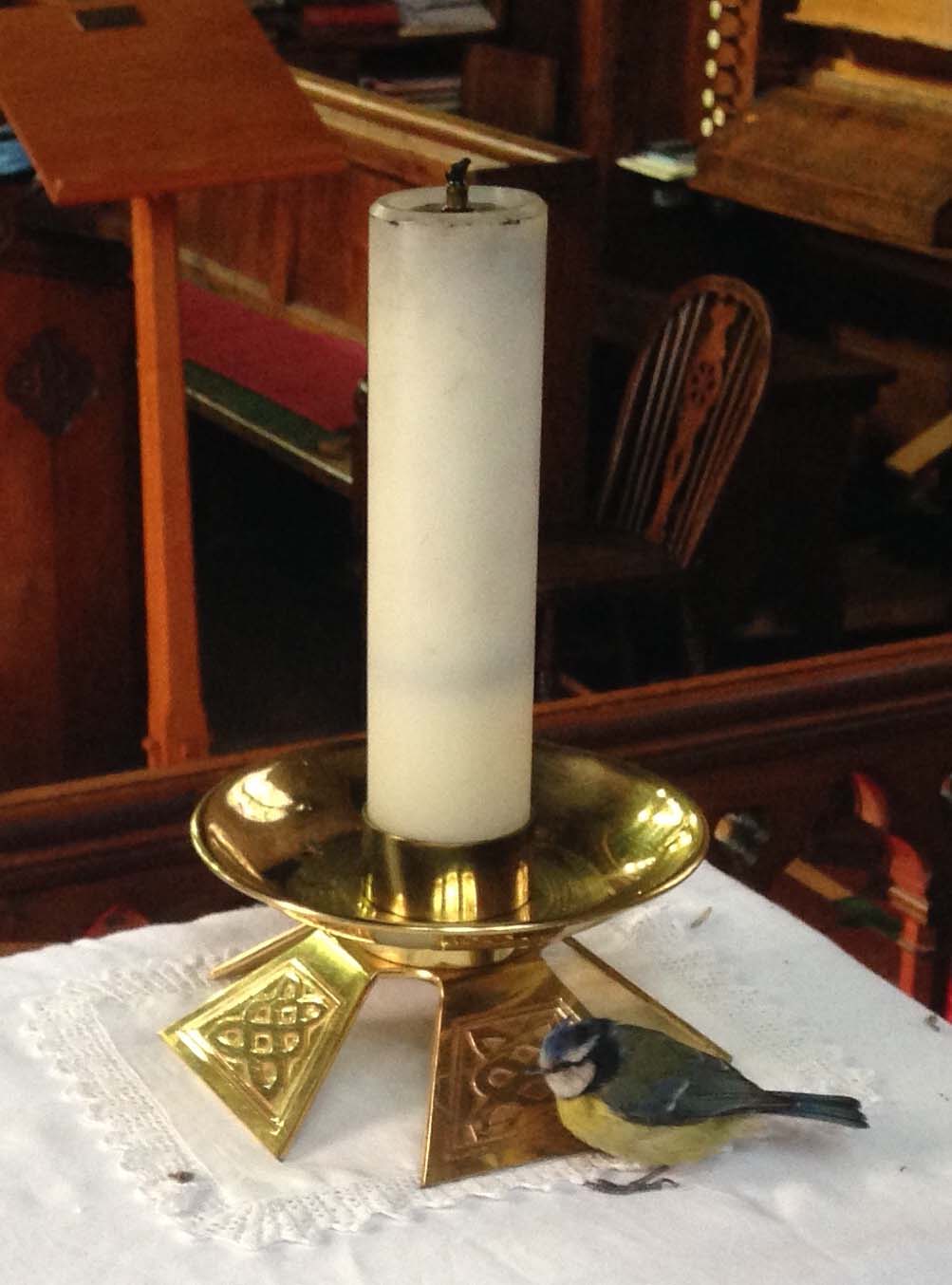
One Friday afternoon, as I arrived at St Matthew’s for ‘Praise and Play’ (our group for pre-school children and their parents or carers), I noticed that the west end doors of the church, and the screen doors, were wide open. The P&P leaders and helpers were spread around the church in a bit of a flap… “There’s a bird in church!”, I was told. And indeed there was. A little blue tit was hopping around the place. He or she (I’m not a twitcher so I wouldn’t know) had made a bit of a mess, here and there, but other than that the only problem was that, with a group of children about to arrive, it was going to be difficult commanding their attention with a bird flying over the tops of their heads. Of course, being a resourceful fellow, it was up to me to save the day. I positioned myself strategically behind the communion table and took a photograph. Having done the most important thing, I then proceeded to organise a plan of campaign. We cleared the bird’s exit and I started clapping. The bird flew halfway down the nave. And then halfway back. This went on for a little while and then, eventually, he or she spotted the exit and went out to enjoy the fresh air. Success!

One of the children who was there (the child of one of the helpers) told me that it was she who had encouraged the bird out of church. Of course, I didn’t disabuse her of the notion, but I knew that it was my efforts that played the major part.

The next most important thing was to make sure that my picture of the bird appeared on Facebook, so I quickly uploaded it. It wasn’t long before my picture was ‘Liked’ and commented on. One of my Facebook friends added a bible reference: Psalm 84. Of course, as a vicar I have the bible pretty much memorised, but I looked it up, just to be sure.

Blue Tit March 2016
It says:

How lovely is your dwelling place, O Lord of hosts!
My soul longs, indeed it faints for the courts of the Lord;
my heart and my flesh sing for joy to the living God.
Even the sparrow finds a home,
and the swallow a nest for herself,
where she may lay her young, at your altars,
O Lord of hosts, my King and my God.
Happy are those who live in your house, ever singing your praise.
(Psalm 84:1-4)

But of course, you knew that too!

I like to think that the author of these verses, had seen those birds nesting in the temple and reflected that, while the temple was the place in which God’s glory was to dwell, it was, at the same time, a place that offered welcome and shelter to the humblest of God’s creatures.

If the temple is the place where God meets with us, then, it makes sense that in the gospels, Jesus refers to his own body as ‘the temple’ (John 2:19). Jesus is the ‘place’ where God and humanity meet. Then the New Testament tells us that our bodies are also the place where we meet with God. Your body is a temple (1 Corinthians 6:19-20)! It is the place where God dwells, by His Spirit (1 Corinthians 3:16).

This, of course, means that our church buildings are not ‘the house of God’, although people sometimes use that phrase. The place where you meet with God is within you and you don’t need a fancy building to do that! At the same time, we have some wonderful buildings at St Matthew’s and St Cross. But they are not the temple. What they are is places where the church meets for prayer and worship, and from which we reach out in love and service to our communities. We are doing our best to take care of the buildings we have inherited, with the hope that we will leave something even better for future generations. At St Cross we are making good progress with underfloor heating to make the place more comfortable. At St Matthew’s we have made a start on a major refurbishment to give us a building that is more welcoming and from which we can better serve our parish.

Our buildings are not the temple, but, like the temple, they need to enable us to proclaim the glory of God and welcome the humble.

Alan Jewell.

Happy Easter!

Occasionally, people ask me why the date of Easter changes each year. Usually I try to bluff my way out of it, hoping to give the impression that I know the answer but that it is too complicated for mere mortals to understand. I do know that, because of its connection with the Jewish Passover, and the Jewish lunar calendar, it is something to do with full moons and the spring equinox. But not actual full moons or equinoxes. No, ecclesiastical full moons and equinoxes that you can look up in tables (not astronomical ones that you would look up into the sky to see). And I know that the Christian calculation parted company with the Jewish one some time in history, so that Easter doesn’t always coincide with Passover. Anyway, you can read all about it on Wikipedia (as I have tried to do) and learn the actual formula which determines that Easter can fall anywhere between 22nd March and 25th April. This year, Easter Sunday is 27th March (if you follow the Gregorian Calendar, as we do in the West. It’s on 1st May if you use the Julian Calendar, as Eastern Churches do. And Passover is a month later, on 23rd April this year.)

Of course, the changing date makes life difficult for some, including schools whose holidays are now fixed in the first week or two of April, rather than being dependent on religious festivals. Some years ago, I got a phone call from a parishioner who worked for one of the utility companies asking if I could let him have the date of Easter for the next few years. I was able to look it up for him and I like to think I made a small contribution to their planning (although I never got a reduction in my fuel bills).

In 1928 Parliament passed the Easter Act, fixing Easter as the first Sunday after the second Saturday in April. The Act has never come into effect, because it would require the agreement of the major Christian churches. Archbishop Justin Welby has said recently that there could be such an agreement within five or ten years (Church Times, 22nd January). Until that time, I will continue to rely on someone cleverer than me to work it out and let me know.

Of course, any change to the calculation will be controversial. In 664 AD, at the Synod of Whitby, King Oswiu of Northumbria ruled that his kingdom would henceforth calculate Easter following the practice of Rome, rather than that of the Celtic church of Iona. In our day, some will be saddened by the prospect of a utilitarian calculation based on the practicalities of the calendar, rather than wrestling with astronomical phenomena. It also finally breaks the link with the date of the Jewish Passover, which some might regret.

The death of Jesus on the cross is linked to the Passover in the gospels. In Matthew, Mark and Luke we are told that Jesus celebrated the Passover – which we remember on Maundy Thursday and call the Last Supper –

On the first day of Unleavened Bread, when the Passover lamb is sacrificed
(Mark 14:12; see also Matthew 26:17 and Luke 22:7).

He was crucified the following day, the day after Passover, which we call Good Friday. But John says that Jesus was crucified on the day of the Passover (John 19:31). How do we explain this apparent contradiction? It’s possible that John is using a different way of dating the Passover – in the year in which Jesus died, it’s possible that the Pharisees and Sadducees disagreed over the proper date. So controversies over dates are nothing new! Or it may be that John is drawing out the symbolism of Jesus as the new Passover lamb, sacrificed like the other lambs for the feast in which the Jewish people remember their liberation by God from slavery in Egypt and their journey towards freedom in the Promised Land, as described in the book of Exodus.

Either way, it is that story which informs the gospels’ understanding of the death of Jesus. He is the Lamb of God who takes away the sin of the world (John 1:29; see also 1 Corinthians 5:7).

Some churches mark Maundy Thursday with a meal, like the Jewish Passover Seder. We are not planning to do that this year, but maybe one year we will. Instead, we will recall the Last Supper with a celebration of the Eucharist in which, rather than eating a meal together, we simply take bread and wine in remembrance of Jesus, who said, “This is my body… this is my blood”.

You’ll find details of our services for Lent, Holy Week and Easter elsewhere. I hope you will put these in our calendar and join us for at least some of them.

Happy Easter!

Alan Jewell

Why did Jesus choose to die?

I had an email from a friend in a previous parish. His granddaughter had phoned to ask a question for her homework:

She wants to know why Jesus chose to die rather than “use his magic wand to escape”.

“Get out of that one”, my correspondent challenged. So, I did my best in a short space of time. After all, a child’s homework can’t wait. Here’s what I said:

In the temptation in the wilderness (Matthew 4:1-11) Jesus has to choose between taking the easy way out and doing what is right. He chooses to obey God, whatever it costs. In Gethsemane, Jesus struggles with what he must face, but again chooses to do God’s will. When Jesus is arrested, one of his followers uses a sword to try to save him, but Jesus says that he could have asked God to send an army of angels to rescue him, but that is not how God’s purpose will be accomplished.
Christians believe that God offers salvation to us because Jesus was obedient “even to death on a cross” (Philippians 2:8). And, “God shows his love for us in that, while we were still sinners, Christ died for us” (Romans 5:8).
So, Jesus chooses to die, rather than use a magic wand to escape, because God loves us.

I’ll be interested to know what mark I get. I mean, what mark she gets…

Evensong – a personal reflection by Kenneth Critchley

As Saint Matthews develops its service patterns, I am pleased to have been asked to provide some thoughts regarding the Evensong service.

At Saint Matthews we are very fortunate to have a bi-weekly Evensong service supported by an evening choir, when many churches have either lost this service altogether or only retain once a month.

The Evensong service connects the congregation to the 1662 Book of Common Prayer and the 1549 and 1552 prayerbooks of Thomas Cranmer. I find a great feeling of strength and continuity in knowing I am saying and singing the same words and phrases that have been said by worshippers of the Church of England for over 450 years.

The Evensong service itself is a wonderful combination of extracts from scripture and deeply thought and expertly crafted text. I find the General Confession and its preamble in particular a deeply moving and thoughtful contemplation of one’s relationship with God.

The service structure with Psalms , the Magnificat, the Nunc Dimittis, lessons from the Bible, The Apostles Creed, the Lord’s prayer (in traditional form), the three Collects, Prayers and Responses constitute a  carefully structured, beautifully balanced and thoughtful form of worship.

The service is further enhanced by singing from Hymns Ancient and Modern and a Sermon able to consider some of the deeper themes to be found in the lessons for that day.

Evensong is a service that binds us to tradition whilst still remaining relevant today.

I would certainly recommend attendance at Evensong for all those who are more traditionally minded and also for those who wish to explore the deep heritage of the Church of England.

I hope these thoughts will have encouraged some of the readers to try the Evensong service over the next few weeks and months.

If you wish to attend, the Evensong Service is currently being held on the first and third Sundays of the month at 4:30 PM until the end of March 2016, when the time will be reviewed.

If you would like to join the Choir: The choir meets to practice the psalms and hymns for 30 minutes before the start of the service.

Kenneth Critchley

The Sign of Jonah

Wednesday 17th February 2016

Jesus said,
‘This generation is an evil generation; it asks for a sign, but no sign will be given to it except the sign of Jonah.’ (Luke 11:29)

Jonah was a prophet. A reluctant prophet. God said to Jonah, ‘Go to the great city of Nineveh and cry out against it!’ So Jonah set out in the opposite direction. He gets on a ship that is going to Tarshish. God sends a mighty storm and the ship is likely to be destroyed. The mariners each cry to their god while Jonah sleeps in the hold of the ship. Why aren’t you praying?, they want to know. They cast lots to find out whose fault it is that the boat is in danger and the lot indicates that it is Jonah. Which god do you worship? I worship the LORD, the God of heaven who made the sea and the dry land. So, what have you done, Jonah?!

Jonah admits that he is fleeing from God and eventually the men throw him into the sea and the storm ceases.

But the Lord provided a large fish to swallow up Jonah; and Jonah was in the belly of the fish for three days and three nights. (Jonah 1:17)

Then the Lord spoke to the fish, and it spewed Jonah out upon the dry land. (Jonah 2:10)

The ‘sign of Jonah’ is a picture of the death and resurrection of Jesus. Jesus is not a reluctant prophet, far from it, but he is ‘swallowed up’ by death in the ‘belly’ of the grave, before being ‘spewed out’ into resurrection life.

In “Wondrous Encounters: Scripture for Lent“, Richard Rohr (American Roman Catholic priest) takes the story of Jonah and uses it as a picture of our spiritual journey. We may find ourselves in the belly of darkness, thrown there by circumstance. Jonah ends up in the place where God wanted him to be, even though he had rushed headlong in the opposite direction. Rohr says our spiritual journey is “more like giving up control than taking control”. In life, we may boldly set out in one direction, perhaps knowing that it is the wrong one, perhaps not, but end up somewhere we never expected to be. Who knows whether we might not end up where God wants us to be, despite ourselves?

Faith is a leap into the unknown. Religion likes certainties and absolutes. (Religion is a ‘first half of life’ activity; faith is more possible in the ‘second half’ of life.) Faith is more like falling or being thrown in at the deep end. Somehow we might just end up where we were meant to be.

Rohr quotes the Danish philosopher Soren Kierkegaard:

“Life must be lived forward, but it can only be understood backward.”

Jonah knows what God is doing only after emerging from the belly of the whale. Despite his best efforts to avoid God’s call he ends up being transformed by it. (Actually, he still has much to learn – spoiler alert: the wicked city of Nineveh hears his message and repents. God changes his mind about destroying the wicked city of Nineveh and that really annoys Jonah! He knew all along that God was merciful. That’s why he fled to Tarshish, so that Nineveh wouldn’t benefit from God’s mercy! Jonah gets really depressed and sits down to sulk. A bush grows over his head and shelters it from the harsh sun. And then God appoints a worm to kill the bush and that makes Jonah angrier still. ‘Why are you angry about the bush? Well, do you not think that I care about the people of Nineveh?’)

“God of surprising journeys, help me to live my life forward, trusting that you are steering the ship. Help me to understand my life backward by seeing and forgiving the many ‘signs of Jonah’.”
(Richard Rohr, “Wondrous Encounters: Scripture for Lent”.)