Numbers and Miracles…

You may have come across this headline:

People of no religion outnumber Christians in England and Wales

To be clear, this is not just that the number of people in church is smaller than those who don’t go on a Sunday. And this is not the fact that active members of the Church of England are in a minority. What this is, is that when you ask people their religion, 48.5% of the population of England and Wales say they have no religion. And the number who say they are Christians, of whatever denomination, is 43.8%.

The increase in those who identify themselves as having no religion has increased massively in a very short space of time. As recently as 2011, the figure was 25%. And by 2014 it was 48.5%. It used to be that people who were not very religious (but who were not actively anti-religion) would put themselves down on forms as ‘Church of England’. That is increasingly not the case. And people who were brought up in a family where religion was practiced now say they have no religion, rather than simply identify themselves with the religion of their parents or grandparents.

Half of those who identify themselves as Christians are over the age of 55. ‘Millennials’ – those born in the period from about 1980 to 2000 are missing from church. We might comfort ourselves by saying that as they get older, get married, have children, they will come back to church. That’s highly unlikely because they are not people who see themselves as Christians who just don’t have time to go to church; increasingly they see themselves has having no religion.

In 1983, those who identified themselves as Anglican made up 44.5% of the population. In 2014, it was 19%. The Church of England has never been good at converting people to faith: we have somehow assumed that everybody in England was more-or-less a Christian unless they identified with another religion, in which case it was in poor taste to suggest they might like to come and join us. Those who do join the Church of England tend to come from another Christian denomination – a transfer, rather than conversion. And for every one person who joins the Church of England, 12 leave it. The Church of England itself predicts that attendance is going to fall for the next 30 years, at least.

Clergy numbers are going to continue to decline as those who retire outnumber those who come forward for ordination. 25% of C of E clergy are aged over 60. Only 13% are under 40. In another profession, people would be asking me about my plans for retirement.

How do we respond?

Abject despair!

This is it. We are the last generation. The church may limp along for a few years yet, but there’s no real future for the church when we have gone. Will the last person to leave kindly turn out the lights?

Guilty Activism

Something must be done! If we don’t get more people coming to church, the collections will continue to go down, we won’t be able to pay our bills. We are in danger of making ourselves and one another feel guilty. Clergy do this all the time!

We are doing some good things: looking at our worship and the way in which we publicise our services. We want to develop the building so that it provides a welcome to visitors. Those are good things. But we can’t do that just to assuage our guilty consciences.

Is there something we have going for us?

It turns out, we believe in resurrection. In today’s gospel reading, Jesus raises the widow’s son from death to life, as an act of compassion and in anticipation of his own resurrection.

The dead man sat up and began to speak, and Jesus gave him to his mother. Fear seized all of them; and they glorified God, saying, “A great prophet has risen among us!” and “God has looked favourably on his people!” This word about him spread throughout Judea and all the surrounding country. (Luke 7:15-17)

A miracle like that would do us a power of good! But we see little miracles here all the time. On Thursday morning, as walked to the front of church to start the service there two people talking to each other, oblivious to me. I stopped for a moment and waited for them to finish their conversation. They looked at me and I looked at them. And it made me laugh. That Thursday morning congregation has in it a number who have suffered loss and bereavement. Some who live with long-term illness in themselves or are carers for others. And on Thursday mornings, we meet here and make each other laugh. There’s a communion service complete with sermon in the middle; but far more importantly, we have a cup of tea and a biscuit afterwards. It’s a group of people who have learned to love one another.

It’s not just the Thursday morning crowd. I’ve had a couple of people say to me in recent days how much they have appreciated the support of the church while coping with difficult circumstances. These are little miracles and they happen here. They are not things that we proclaim from the rooftops but we give thanks to God because we sense that God is here amongst us.

On Pentecost Sunday, we had a service of all-age worship. There was quite a group of younger children, some currently part of Praise and Play, some now part of the school. They came and sat on the carpet on the front. I did a magic trick, creating a cake to celebrate the church’s birthday and we sang a children’s song. And while I was talking, one little lad engaged me in conversation. At one point he was telling me that his trousers had a pocket in. It’s become one of my favourite things: sitting on the step at the front of church with the Praise and Play families on a Friday afternoon and with the children who come to our all-age services.

We live in a society where people are increasingly isolated. The elderly who never see a living soul from one day to the next. People of working age who never get time to be with their families. Young women with children who long to have another adult to talk to. People who live with mental health problems and don’t fit in. Young people who spend hours a day looking at a screen, not another person. Church is the opposite of social isolation. Church is where you come through the door and you belong. From the youngest to the oldest of us, this is our space where we matter and so does everyone else.

Conclusion

What if that got out? That this was the place of little miracles? Where people get to know themselves loved? And commit to learning what it means to love one another? Maybe it will be a while before we have queueing round the block, but you never know!
Evening Worship at St Matthew’s

Thank you to everyone who responded to our questionnaire on evening worship. There were 46 replies, which is pretty good! Of those, 14 people identified themselves as evening worshippers. The questionnaire asked you to state your preference for:

  • the frequency of the service. (Currently, we usually have an evening service on the first, third and fifth Sundays of the month but there was a suggestion that we return to a weekly evening service.)
  • the time at which the service is held. (It had been at 6:30PM but is currently at 4:30PM. The suggestion was made that we consider changing the time in summer and winter.)
  • the style of the service – Book of Common Prayer or contemporary worship.
  • and, lastly, the style of the music – traditional hymns or contemporary songs.

The results of the survey were presented to the PCC at its meeting on 19th May and the PCC made some decisions. Just to be clear, this was not a referendum. It was an exercise in consultation: the vicar and the PCC take responsibility for the services we provide. We sought your views but the final responsibility remains ours. That said, this is where we got to!

The PCC has decided the following:

That, wherever possible, there will be an evening service at St Matthew’s each week.

Obviously, we need to be confident that we have the resources for a weekly service, which includes a minister to lead, a warden or sidesperson to take care of the practicalities, and, where possible, musical resources including an organist and choir.

On occasion, we may join with other churches in the Deanery, or as Bridgewater Churches Together, and that will replace our own evening service; there will also be times when the vicar is holiday and no-one is available to cover, but our usual pattern will be to have weekly evening services.

That the time of the service will change seasonally – 4:30PM in the winter and 6:30PM in the summer.

There isn’t a time that suits everybody, of course, but most people seem happy with this arrangement which allows people to go out for longer on balmy summer afternoons and get home earlier in the darker winter months. We have decided to make the change when the clocks go forward for British Summer Time and back for Greenwich Mean Time. (That’s on the last Sunday of March and the last Sunday of October.)

That evening services will mostly use the forms of worship found in the Book of Common Prayer.

There were some voices raised for more contemporary services, including the suggestion that we put something on that would better suit young people, but the prevailing view was that we mostly use the traditional BCP form of Evening Prayer. In months when there is a fifth Sunday, we will continue to offer a service of Holy Communion, from Common Worship, and on occasion, we will do something different. For example, this year, on the evening of Palm Sunday, we put together an expanded choir to lead a service of music and readings which we called “The Journey into Holy Week”; there might be occasions when we do something more reflective – using material from Taize, Iona or other sources – as we do when we offer Compline in Lent and Advent.

Ideally, the PCC would like the services to be led by the choir each week. I don’t know if this will be possible: the choir has a few very faithful members, to whom we are grateful. It is, however, sometimes a struggle getting enough singers together to lead a successful choral service. But we are going to try! (It may be that there are others who would like to join the choir and learn how to sing the psalms and canticles as we do at evensong.)

That we will mostly use traditional hymns at evening services.

Here the voting was tight, between those who want mostly traditional hymns and those who would prefer a range of traditional and contemporary music. (Nobody wanted ‘mostly contemporary hymns and songs’, so my ideal service – a rock mass, led by a band – isn’t going to be happening just yet! But I live in hope!).

None of the above is set in stone (apart from the vicar’s desire to see rock music in worship) but the PCC has decided that this will be the usual pattern and style of evening worship, starting in July this year, and to be reviewed by Christmas. If you have any observations on our proposals, please let me know.

Morning Services

And that brings me to our morning services… Sadly, in common with many other churches, our Sunday attendance is dropping. Some of the attendance figures for our 10:30AM services are, frankly, quite alarming. We do well on special occasions – Mothering Sunday, Remembrance and so on – and the attendance at All-age Worship (on the third Sunday of the month) is OK. The 10:30AM Communion service (first Sunday of the month) is not doing too badly (although attendance has gone down over the years). That leaves the second and fourth Sundays of the month. Here the figures are shocking and we clearly need to look at what we are doing on those Sundays.

I know that there is a group of worshippers who regret the loss of BCP Matins. I’m also aware that the cessation of Matins was handled badly: I apologise for that. But I don’t think that returning to BCP at 10:30AM is the answer to falling attendance. Before I was appointed to this post, the PCC had decided that all morning services should be contemporary in style and all-age friendly (not just ‘Family Services’ once a month). I believe that that is right and I am committed to that. The PCC has agreed that the evening service will concentrate on meeting the needs of those who value more traditional provision. (There are also communion services at 8:00AM each Sunday and at 10:30AM on Thursdays which cater to those with more traditional tastes.) So, morning services will be our ‘shop window’, the place we are looking to reach out to a wider, younger group of potential churchgoers. But how do we do that?

To be clear, this is not a criticism of those who plan and lead the 10:30AM services. We are doing our best! I suspect that this is partly a modern phenomenon: years ago, regular churchgoers would attend every week, unless sick or away. There were fewer alternatives for Sunday activities. These days the competition is fierce, from shopping to sport, and other commitments which families, in particular, have on Sundays. This means that regular worshippers these days probably expect to come to come to church about once a month. And people pick the Sunday in the month that best suits them. We do have a group of families that come when it is all-age worship, and there are people who prefer to come when it is a communion service. There was a group that came when it was BCP Matins. (There was also a group that stayed away from Matins!) But I don’t think there is a group of people whose preferred option is ‘non-eucharistic, non-all-age’ services, so that is what the PCC needs to look at next. (In my view, there are some terrific resources in Common Worship and elsewhere which can be used to make services which are meaningful, enjoyable and valuable.)

I have to say that I’m not sure that replacing Morning Prayer with either communion or all-age worship is going to be possible. One issue is that you only have one vicar[1] and I have two churches, both of which have services at 10:30AM every Sunday. I believe that some mystics and wizards have mastered the skill of bilocation (being in two places at once), but I have yet to accomplish that. Sadly, we don’t have a curate or assistant priest. St Cross has a communion service twice a month at 10:30AM and so, by default, I am there. Equally, I am usually at St Matthew’s on the first Sunday of the month, and I choose to lead the all-age worship services as that’s the thing I enjoy the most. The trouble then is that St Cross folk wonder why I don’t lead all-age worship there very often. The answer is that it is on the same Sunday as communion at St Matthew’s. I would love to be at both churches for the main morning service each week, with the support of colleagues. I hope that both churches would be happy to have me each week! But our current arrangements do not allow that.

There is also the ‘monthly worshipper’ phenomenon to consider: if we had All-age Worship twice a month, the ‘all-age’ crowd might simply split itself between the two Sundays when this is on offer. Those who prefer communion might not come twice as often if we had two morning communion services.

As we have asked you to think about the music we use in our evening services, it would be helpful to know what hymns you think we should sing in other services. We could then see if our current hymnbooks are adequate, or whether we should consider a new book or the possibility of having words projected on a screen so that we never again have to print a hymn sheet when the person leading the worship chooses hymns and songs that are not in one of our books.

That, then, is the task facing us. The PCC will again use a form of consultation before making a decision about our Sunday morning services. In the meantime, please continue to enjoy what we are doing and tell all your friends: they don’t know what they are missing!

Alan Jewell

[1] On current forecasts there will be 20% fewer stipendiary clergy across the Church of England by 2022. C of E Statistics for Mission 2012.

The Rose Queen… and King!

When children ask questions, I believe that it is right to give them the best answer you can. So, when a child recently asked why, if we had a Rose Queen, we didn’t also have a Rose King, I decided I would give the matter some thought. It’s a good question! When I was newly-arrived in this parish, never having had much to do with Rose Queens in the past, I did a bit of research. Some people imagine that it’s an ancient pagan tradition, with its origins lost somewhere in the mists of time… Steve Roud, however, in his book “The English Year[1]”, tells the story of a vicar in Bury who, in 1989, announced that he was banning his church’s Rose Queen ceremony, because, he said, it was rooted in pagan rites and not appropriate to a Christian community. Roud points out that that the hapless vicar:

“had fallen rather publicly into the trap of believing that all traditional customs must be extremely old, and are therefore linked to pagan activities. The Rose Queen was in fact a late Victorian invention encouraged, and perhaps even created, by clergy and respectable churchgoers as a piece of safe and controlled pageantry.”

Roud also points out that Warrington Walking Day goes back only to 1833, and was an attempt by the Rector of Warrington to combat the evils of gambling and strong drink available at the racecourse.

The Victorian enthusiasts liked to believe that they were rediscovering the joys of medieval Merrie England, whereas they were, in fact, mostly making stuff up.

There is, however, a possible precedent to the Victorian notion of a Rose or May Queen. It is to be found in the medieval tradition of ‘Church Ales’. The Church Ale, often held around Whitsun (the feast of Pentecost), and therefore sometimes called the ‘Whitsun Ale’, was a fundraising event for the upkeep of the parish church, which involved food, drink, dancing and games. Not that different from our current Walking Day, in fact. King James I listed Whitsun Ales as suitable entertainment for Sundays, but, with a change in the religious climate, they were banned by parliament in 1644.

Now, this is where it gets interesting! The ‘ale’ festivities were ruled over, not by a May Queen, but by a ‘Lord’ and ‘Lady’. So, if our Rose Queen has a precedent in the Lady who presided over the parish ‘ale’, she should be accompanied by a Lord!

Ladies and gentlemen, boys and girls: it’s not just political correctness to have a Rose King, alongside the Rose Queen. It has historical precedent!

The only other parallel I could come up with was the tradition of the Boy Bishop, in which a boy (usually a chorister) was appointed ‘Bishop’ for a time. He was dressed in a bishop’s garb and given duties to perform, including leading processions and preaching sermons. The boy was usually elected on the Feast of St Nicholas’ (6th December) and served until Holy Innocents’ Day (28th January). So, the Boy Bishop held his post from the feast of the patron saint of children, through the Christmas season, until the day when the church remembers the children slaughtered by Herod in his bid to rid the world of the boy Jesus. The tradition of the Boy Bishop turns the usual order upside down, and reflects the teaching of Jesus about children: we tend to tell children that they should learn from adults. Jesus says that adults need to learn from children (Luke 18:17).

On Pentecost Sunday  (15th May) we will select (by ballot from those who put their names forward), a Rose Queen and her retinue. We may also (if there are candidates!) select a Rose King. We look forward to welcoming the children who will teach us the way to serve in the kingdom of God.

[1] The English Year, A month-by-month guide to the Nation’s Customs and Festivals from May Day to Mischief Night © Steve Roud 2006, Penguin Books

Men and the Church

In my previous diocese, clergy were asked to fill in a form for the Archdeacons’ visitation which included the question: ‘what does your parish do for men?’ I was tempted to reply, ‘I don’t know what it’s done for anyone else, but when I came here I was two stone lighter and my hair was dark’!

Someone once said that the Christian Church is like a lifeboat: it’s for ‘women and children first’. In many church congregations, women seem to be in the majority, followed by children. Young adults and men, in particular, seem to be missing. Why is that?

Of course, when it came to ordained ministry, until fairly recently, the picture was reversed: priestly ministry in the Church of England was a club for men only. The C of E started ordaining women priests in 1994. In 2012, 490 new clergy were ordained: 269 were men, 221 female[1]. In 2014, the Church of England saw its first woman bishop, the Rt Revd Libby Lane, Bishop of Stockport.

65% of churchgoers in the UK are female[2], so they are in the majority. Part of the answer to why that is may be to do with age. The average age of a churchgoer is 61, whereas the average age of the general UK population is 40[3]. Given that women have tended to live longer than men, you might expect more women in church than men. But it isn’t necessarily a modern phenomenon:

In 1904, religious writer Richard Mudie-Smith conducted a census of Church of England attendance in London and found that 84,602 women were present compared to just 46,343 men – almost a two to one ratio.[4]

Other religions in this country don’t seem to have the same gender balance: Islam and Judaism have more male adherents than female. So why is the Christian Church more appealing to women than to men?

Is it that men more rational, and don’t accept religious teaching? Perhaps it is because men are notoriously bad at dealing with emotions. I have often seen someone in tears in church, simply because they have heard a hymn with particular associations (it was sung at a parent’s funeral, for example). Perhaps it is because women are better at talking about personal things. Men seem to substitute sport for personal interaction. “Did you see that game? That was never a penalty!” may be as deep as some men’s conversations ever get! Or perhaps it is because men have traditionally been career-focused, leaving women to look after children, including taking them to church on Sunday. Or is it the case that, having spent a hard week at work, men prefer to relax on Sundays, washing the car, mowing the lawn or playing golf? Of course, those stereotypes are dated, but there may be something in them, given the average age of churchgoers.

In a 2011 book, a Christian author, David Murrow asks: “Why Do Men Hate Going To Church?” David Murrow is the Director of Church for Men. The organisation’s website[5] offers to put you in touch with a ‘Man Friendly Church’. You can even get a study guide to look at with the book, to ask how your church can become more man-friendly. It’s a question we might like to ask of our own churches: how ‘man friendly’ are we?

Jesus, of course, has no trouble relating to either men or women. I have often preached on his radical acceptance of women and children, in a culture that was very male-dominated. But perhaps we should start to think about how Jesus worked with men. Jesus seems to have had no problem talking to men of different social status – fishermen and tax-collectors, centurions and rulers. After all, the twelve apostles were men.

The gospels are full of Jesus’s encounters with men: Nicodemus, Zacchaeus, Jairus, Herod and Pontius Pilate – as well as the many men, blind, lame and oppressed by demons, whose names we don’t know. And, in Mark 10:17-31, the man we know as the rich young ruler.

Here is a man with a desire to understand: he asks Jesus the question, ‘Good Teacher, what must I do to inherit eternal life?’ Jesus plays with him: ‘Why do you call me good? No one is good but God alone’. Jesus runs through the commandments for him, and the man, as far as he can tell, has kept them. He has been faithful and devout. So what’s missing? Jesus puts his finger on it. This man who wants to know how to be good is a wealthy man. Jesus challenges him:

Jesus, looking at him, loved him and said, ‘You lack one thing; go, sell what you own, and give the money to the poor, and you will have treasure in heaven; then come, follow me.’ When he heard this, he was shocked and went away grieving, for he had many possessions. (Mark 10:21, 22)

I don’t think this is a general prescription: that all Christians should (literally) give up all their possessions – although some, like St Francis of Assisi, have done so. But Jesus knows that for this one man, although he appears open and seeking after truth, the stumbling block is that he is really deeply wedded to his wealth. Perhaps men are locked into a view of themselves in which their value is rooted in their material wealth? How hard it is, Jesus says, for someone who is rich to enter the kingdom of God! Easier for a camel to go through the eye of a needle! (V25) In other words, it’s impossible for a wealthy person to be saved. The disciples are astonished: if the rich aren’t God’s favourites, then what hope for the rest of us?

Jesus’s answer is that rich men and women are saved on the same basis as the poor. We are saved because God chooses to save us, because God loves us. Not because of what we have achieved or earned in life.

Perhaps that is why some men find religion difficult: because men have been told that their worth is to do with their accomplishments, their achievements? And the bible says we are saved, by grace, unmerited, unearned love:

For by grace you have been saved through faith, and this is not your own doing; it is the gift of God — not the result of works, so that no one may boast. For we are what God has made us, created in Christ Jesus for good works, which God prepared beforehand to be our way of life. (Ephesians 2:8-10)

We are saved, not by our own goodness, but because of God’s goodness. We do good works, not in order to impress God, in order to get God to accept us, but because it’s what God created us for. (And we’ve all come across the self-made man who worships his creator…)

Perhaps it’s difficult for men, to allow themselves to be accepted by God without that being something we have to work for? Men who have been taught that their worth, their value, lies in what they have achieved, earnt, rather than simply knowing themselves to be valued by God?

Jesus ‘loved’ the rich young man, but he still went away grieving, shocked to discover where his heart really lay, in his material wealth.

Men (and women and children) need to know where true wealth is to be found. Jesus talks about the man who discovered treasure in a field, or the merchant who finds a pearl of great value. They sold all that they had to obtain that which was of far greater value (Matthew 13:44-46). Jesus tells us that the Kingdom of God is the thing which is to be valued above all else: we should let go of everything else in order to find it.

Jesus says we are to:

…store up for yourselves treasures in heaven, where neither moth nor rust destroys, and where thieves do not break in or steal; for where your treasure is, there your heart will be also. (Matthew 6:20, 21).

So, men, here’s the challenge: are we prepared to put all other things aside in order to gain the Kingdom? And are we ready to share that message with those around us? Jesus tells us not to worry about material things. God knows what we need. We are to:

…strive first for the kingdom of God and his righteousness, and all these things will be given to you as well. (Matthew 6:33)

[1] https://www.churchofengland.org/about-us/facts-stats.aspx

[2] http://www.telegraph.co.uk/women/womens-life/10035155/Why-do-more-women-flock-to-the-Church.html

[3] Office for National Statistics, Social Trends 2009

[4] http://www.telegraph.co.uk/women/womens-life/10035155/Why-do-more-women-flock-to-the-Church.html

[5] http://churchformen.com/community/about-david-murrow/

Happy Valentine’s!

I’m not sure the post office will be overly troubled when it comes to delivering valentine’s cards to the vicarage; no need to put on extra staff or hire a couple of vans to handle the volume. The number of cards I’m expecting to write – and hoping to receive – is exactly one. (No more, no less.)

The origins of St Valentine’s Day are a bit obscure. Wikipedia tells me that there may have been more than one early Christian saint named Valentinus. The most famous story is of a Valentine in Rome who, when Christians were being persecuted for their faith, performed weddings for Roman soldiers who were forbidden to marry. This Valentine was executed for his crimes and sent a farewell letter to the daughter of his jailer (whom he had healed), signing it “your Valentine”.

We’ve come a long way from the death of a Christian martyr to the Hallmark festival of cards, teddies, balloons and chocolate. As it happens, this year St Valentine’s Day falls on a Sunday. But it also happens to be the First Sunday of Lent, so all those chocolates (and the prosecco) should be put away until Easter… My guess is that not many of us will be able to do that.

Given that St Valentine’s Day falls on a Sunday, I have decided to invite all the couples who are planning weddings at St Matthew’s to come to the church that afternoon. I’m not sure how many will be able to do so. I was told that they have probably all got other plans… It also falls in the school half-term holiday, so that may take a few away. But some couples have already replied to say that they will be able to join us, so it is definitely going ahead! Some are bringing parents, bridesmaids and best men, too. What I would like to do is to welcome them all to the church with refreshments (maybe even something sparkly to drink, if someone would be kind enough to donate a few bottles!) and help them to feel at home. Often those who book weddings with us are not very familiar with the church and find the place a bit daunting, especially when they are nervous about their special day. This will give them chance to make themselves feel at home, and the opportunity to ask questions. Often wedding couples email me to ask things like how many pews there are (so they know how many pew ends to order) and where the bridesmaids will sit. This valentine’s afternoon will enable them to familiarise themselves with the building and think about those all-important decorations and seating plans.

I’m hoping that those who are involved with weddings will be represented – the choir and bell ringers, for example. I’ve booked the organist (the one I’m hoping to get a valentine’s card from) and asked her to play the Bridal Chorus and Wedding March for people to hear. Mind you, that will probably make them (and her) even more nervous! It would be good to have a number of regular worshippers there too, to chat with couples and their families, and express the church’s welcome.

If you are able to join us, we will be in church at 3:00PM on St Valentine’s Day (that’s 14th February, if you weren’t sure).

The other thing I’ve done, which I know used to happen at St Matthew’s and which I think is a great idea, is to ask couples to let me have a photograph of themselves. I’m planning to put these up at the back of church so that the congregation can see who it is that is getting married. When you see the photos I hope you will spend a moment to pray for them and for all who are preparing to be married.

“The course of true love never did run smooth” and all of us face challenges in our relationships with one another. Those who are to be married need our prayers and our support. The Beatles summed up the 1960s with their anthem “All You Need Is Love”. But Saint Paul the Apostle said it first, following the life and example of Jesus: there are three things that have eternal significance. They are faith, hope and love.

And the greatest of these is love. (1 Corinthians 13:3)

Love from …


Wassail!

After one of the carol services I attended – with the good folk of St John Ambulance, Cheshire, at St Mary’s, Weaverham – I heard someone asking the vicar, Andrew Brown, why there wasn’t a standardised version of the carols we had sung. At a previous carol service, a day or two earlier, the words of some carols were different to the ones in that day’s service. It’s a variation of that question asked of all vicars: “Why do they keep changing the words (or tunes) of hymns?” Part of the answer is that ‘they’ have always done so. Take, for example, that most favourite of Christmas hymns:

“Hark! the herald angels sing,
Glory to the newborn King.”

Who would dare tinker with such a classic? Who would change the words that Charles Wesley wrote for his Christmas day hymn? The answer is George Whitefield, Wesley’s contemporary (or rival). He was the first to change the words of Wesley’s hymn. In fact, it was Whitefield, not Wesley, who wrote that familiar opening line about the herald angels. What Wesley actually wrote was:

“Hark! how all the welkin rings,
Glory to the King of kings.”

If you look for the original version, you’ll recognise many familiar lines, but also many differences from the version that we now sing. There’s no refrain, for example, and there are verses that haven’t made it into the hymnals and carol sheets that we use today. Also, there’s no mention of any angels, herald or otherwise. Wesley wrote his hymn in 1739 and by 1753, it had been altered by Whitefield. It changed again in 1782 when Tate and Brady published it with the now-familiar refrain. And the tune we most associate with the hymn is not the one that Wesley envisaged. It wasn’t until 1856 that an English musician named William Cummings adapted a tune from a work by Mendelssohn to fit the words of the hymn.

Still, there’s nothing nicer than a good old traditional carol service, is there? Except that the format that most people think of – the Festival of Nine Lessons and Carols, as presented by King’s College, Cambridge – isn’t traditional at all. It’s a twentieth century innovation! It was first held at King’s on Christmas Eve in 1918. Eric Milner-White, the Dean, had been an army chaplain. As the First World War ended, Milner-White believed that the Church of England needed more imaginative worship. The idea was to tell the whole story of God’s redemptive purpose, all the way from the fall of Adam and the call of Abraham, through the vision of the prophet Isaiah, to the birth of Jesus and the visits of shepherds and wise men.

Actually, I exaggerate when I describe the Nine Lessons as ‘a twentieth century innovation’. Its use in Cambridge is rooted in an earlier service, first used on Christmas Eve 1880, by Bishop EW Benson, “in the wooden shed which then served as his cathedral in Truro”. Bishop Benson’s innovation was to have carols sung in the cathedral at 10:00PM on Christmas Eve. Before that, the choir had gone round to people’s houses to sing carols, a practice rooted in the ancient tradition of seasonal wassailing. Now, this is where it gets interesting! Some of the carols we still use today are connected to the wassailing tradition which is pre-Christian. The word ‘wassail’ means ‘be hale’. In other words, to wassail is to wish someone good health; which we still sometimes do when taking a drink. We drink to the health of our drinking companions, or to absent friends. The wassail bowl, ‘made of the white maple tree’, was filled with ale, cider or spiced wine, which the householder supplied, and from it, the wassailers would drink to your health. The correct response to the greeting, ‘Wassail!’ is ‘Drinc hael!’, which means ‘drink healthily!’

The traditional time to go a’wassailing was on twelfth night – that is, 5th January, the eve of Epiphany. Wassailers would go from house to house, or, in the West Country, to orchards, singing to cider apple trees, and making loud noises, in the hope of awakening them from their winter sleep in order to produce a good harvest.

The pre-Christian origins of some of our Christmas carols can be seen in, for example, ‘The Holly and The Ivy’, which began life as a folk song about those evergreen plants. Holly was sacred to druids and to the Romans, and associated with the winter solstice (21st December) or saturnalia (17th or 23rd December). Evergreen plants were adopted by Christians as symbols of life in the darkness of winter, but those associations predate their use as Christmas decorations. Christians also took those songs and adapted them to include Christian themes.

So, where does all this get us? You think that it’s traditional to sing ‘Hark the Herald Angels’ at a service of Nine Lessons and Carols in church. And I’m saying that what’s really traditional is to go around the parish drinking people’s health and singing songs about evergreens.

I’m being flippant, of course. Partly. And I may have got a bit carried away. A bit. But this article started as an attempt to talk about the difference between tradition and nostalgia. I have been trying to come up with definitions of the two things. How about this:

Nostalgia is a sentimental attachment to the notion that things used to be better, or at least simpler, at some point in the past, in some golden age.

Tradition is a bedrock of tried-and-tested principles and practices that give a firm base on which to build and explore the present and the future.

You won’t be surprised to learn that I think that tradition is hugely important to the life of the church and of all communities. And that nostalgia is a deadly, life-sapping virus. Again, I might have overstated my point, but I think you will see what I mean. Nostalgia longs for the past. Being firmly rooted in tradition gives us the confidence to strike out for the future!

You may be reading this around Christmas, New Year, or the feast of the Epiphany. In which case, let me say to you:

Wassail!

(And I hope you will give me the appropriate response.)

Alan Jewell

Who Are You?

I’ve just heard an interesting story from a couple who are members of the congregation at St Matthew’s. They had a meal with friends who attend the 8:00AM service. While there, they met some other friends who attend the weekly Thursday morning service at St Matthew’s, and then some other friends who come at 10:30AM on Sundays. It turns out that none of these other friends knew each other, despite them all attending the same church! (I thought it was disappointing that they didn’t then bump into some of the 6:30PM congregation and complete the set.)

At St Cross, the situation is simpler: there is just one service on a Sunday, and a monthly midweek communion, which is usually attended by people who also come on Sundays. So, people at St Cross tend to know one another. But across the two parishes we have four or five congregations who may or may not know anyone who worships at another time or in another place.

In one sense, this is not a problem. Many of us are creatures of habit and attend church at a time and place to suit ourselves. Each of the services has its own characteristics and we find a congregation in which we feel at home. There’s nothing new in this: the Bishop of Willesden, Pete Broadbent said in a light-hearted note on growth in the Church Times:

“it always used to be 8 o’clock for the individualists, 10.30 for the families, and 6.30 evensong for the depressives!”

Obviously, we don’t want to categorise all churchgoers in such a simplistic way, but it makes the point that people like choice and the church tries to offer a variety of styles of worship to appeal to the greatest number. Church growth research also suggests that people like a certain amount of predictability from one week to the next. (We decided to lose Matins at St Matthew’s because it was so different from anything else in the 10:30AM slot: people who come to All-age worship one month and then Book of Common Prayer Matins the next – or vice versa – wonder what kind of church we are, contemporary or traditional? If you love one, you might hate the other.)

At a recent PCC morning (yes, your church councillors gave up a Saturday morning to think about how we can encourage the church to grow!) we looked at attendance at St Matthew’s. Like many other churches, we need to face the uncomfortable reality of aging congregations and declining numbers (along with financial worries and the demands of looking after a Grade II listed building). The service registers tell us that All-age worship is the best attended service of the month (particularly on special occasions), followed by our monthly Parish Communion at 10:30AM. Attendance at the other 10:30AM services is sometimes worryingly low. 8:00AM communion is fairly steady, and the 6:30PM congregation consists of a small number of stalwarts, mostly older people, who love their BCP service.

We are trying to develop our styles of worship so that people have confidence in what they come to and what they might invite others to attend. The Christian website Ship of Fools sends a mystery worshipper to drop in on unsuspecting church services to see what they offer to visitors. What would a mystery worshipper make who attended one of our services? Do we have something that we can offer with confidence to a visitor?

But back to the point with which I began: how can we encourage our diverse congregations to become better acquainted? (If we think that’s a good idea!) Of course, there are various social and fundraising events throughout the year – from Walking Day and coach trips, to Christmas Fairs and concerts – which encourage people from each of our congregations and beyond to meet one another. And this month of September sees both churches marking their patronal festivals – Holy Cross day and St Matthew’s day fall a week apart each September (on the 14th and 21st respectively). Both churches are holding special events on the Sunday nearest to encourage church members to meet each other, and to reach out to those on the margins and beyond in our communities. Of course, calling it a ‘patronal festival’ is hardly likely to draw in the crowds, but it gives both churches an opportunity to celebrate what is good about our shared life and our service to our parishes. I hope that you will get involved with one or both of these occasions. Who knows? You may meet someone who is a regular worshipper at your church whom you don’t yet know. Better still, we might meet some parishioners who are not yet regular worshippers but who might just like what they see and consider coming back for more…

St Cross: Come on and Celebrate! Sunday 13th September

4:00PM on Sunday 13th September at St Cross. Open air worship (weather permitting) followed by craft activities and refreshments in church.

St Matthew’s Church Festival Sunday 20th September

10:30AM on Sunday 20th September. All-age worship, followed by refreshments. Hopefully, afternoon tea later in the day (volunteers and cakes required!) and Evensong at 6:30PM.

If you can help with any of these events, please let me know.

Alan Jewell

On Forgiveness

It isn’t every day that forgiveness makes headlines, but it does happen occasionally. This week saw the case of the Bradford teacher, Vincent Uzomah, who was stabbed by a 14-year-old boy in the classroom. The teacher, a practising Christian, says he has forgiven his attacker:

Mr Uzomah said: “I have forgiven this boy… I pray he will make use of the support provided to him to become a changed person.”

We may also remember the story of Gordon Wilson who lost his daughter, Marie, and was himself injured when a bomb planted by the Provisional IRA exploded during Enniskillen’s Remembrance Day parade in 1987. Mr Wilson spoke movingly of his daughter’s last moments and said

“I bear no ill will. I bear no grudge”

He said he had forgiven those who planted the bomb, that he would pray for them, and called for no reprisals from Loyalists. He later went on to meet members of the IRA in order to try to understand their views and motives.

I have no idea how I would react if I found myself in circumstances anything like those described. I still haven’t seen the BBC drama, A Song for Jenny, which tells the story of Julie Nicholson, a vicar whose daughter was killed in the London ‘7/7’ bombings. Ms Nicholson resigned her post and poured her anger and grief into the memoir on which the TV drama is based. She said

“I can’t pretend I have much forgiveness in my heart for the person who took my daughter’s life”

Her response is probably easier to understand.

One of Jesus’ disciples, Peter, asked him

“Lord, if another member of the church sins against me, how often should I forgive?” (Matthew 18:21)

Knowing Jesus to be a generous sort of guy, Peter sets the bar high:

As many as seven times?

he wonders. But he’s way short of the mark.

Jesus said to him, ‘Not seven times, but, I tell you, seventy-seven times.’ (Matthew 18:22)

Jesus tells the story of the king who settles accounts with his officials (Matthew 18:21-35). One of them owes him millions – money he can never pay back. The king orders him and his family, and everything he owns, to be sold, but the official begs for mercy. The king is moved by his plight and sets him free.

In scene two, this same guy comes across one of his fellows who owes him a few quid. He is deaf to the man’s pleas for mercy and has him thrown in debtors’ prison. When news of his behaviour gets back to the king, we’re not surprised that the king’s anger falls on the man who, having been forgiven, refuses to forgive.
Jesus concludes, rather uncomfortably, that’s that what God will do to us if we do not forgive others. It’s a tough lesson, but it links the forgiveness we get with the forgiveness we give. Of course, our forgiveness and God’s are not on the same scale. We’ve racked up millions in debt. God in Christ forgives us our unpayable debt. We then are expected to forgive the trifling sums to which others are indebted to us.
This should come as no surprise; every time we pray the Lord’s Prayer, we pray:

Forgive us our sins
as we forgive those who sin against us.

It’s like the old story of how to catch a monkey. Apparently, you hollow out a coconut through a small hole and put some rice inside. You then tie the coconut to a tree. The monkey comes along, squeezes his hand through the hole in the coconut and grabs the rice. But with a fistful of rice, the monkey’s hand is now too large to pull out of the coconut. The monkey has a choice: let go of what he is holding on to or remain trapped.

To forgive means letting go and getting free.

Welcome?

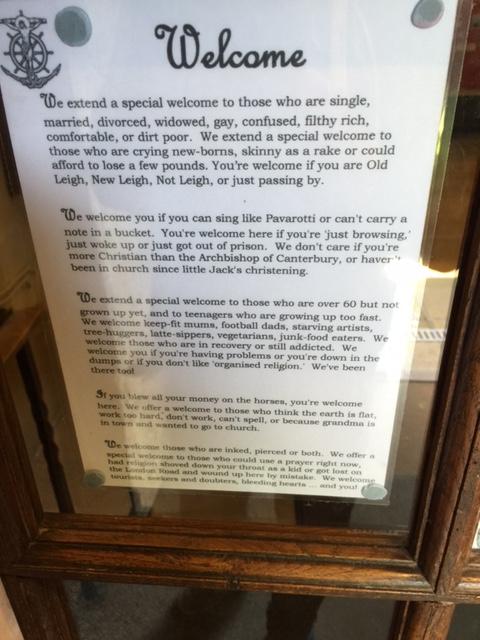
You may have seen on Facebook or elsewhere on the internet a welcome notice which apparently appeared at St Clements Church, Leigh-on-sea, Essex. Please read that, then come back here…
welcome
What did you think? The notice says that the church welcomes everyone, regardless of where we are up to in life or where we have come from. I’m pretty sure that’s what Jesus says: in God’s kingdom, all are welcome. The question is, does the church offer the same welcome?
I remember a story that Adrian Plass tells. (Adrian is a Christian writer and speaker. I’m re-telling it from memory, but the story goes something like this.) He says he was in a supermarket and saw a sign that said “This supermarket would be very pleased if customers reported any spillages to staff.” Around the next aisle he spotted a broken jar of pickle on the floor that had apparently been knocked off one of the shelves. Aha! He thought – here’s my chance to make the supermarket happy! And he duly reported the spillage. The member of staff to whom he reported the spillage looked anything but happy. They rolled their eyes wearily. “I’ll tell the manager”, they said. The manager was called and was told “This customer is complaining about a spillage in the pickle aisle.” Plass didn’t think he was complaining; he thought he was making the supermarket happy; at least, that’s what the sign said.
Adrian Plass’s point is this: the supermarket had a sign but there was no-one actually in the store to make the claim on the sign a reality. He says that church can be like that. We have a sign – from God! – that says that all are welcome. But unless the people in the church make that sign a reality, it amounts to very little.
So, the question to the church is, How good are we at making God’s welcome a reality? Not just to people like us, but to all people? We’ve all heard stories of visitors to churches being told, “You’re sitting in my pew!” Hopefully, we have got past that. We certainly need to! Unless our welcome is genuine, the church dies with us. And none of us wants that to happen.
At the time of writing, I am looking forward to my first experience of Walking Day. It’s been a bit of a struggle making it happen, to be honest. A number of people have worked very hard to make sure that the tradition continues. What is walking day? To be honest, I don’t really know as it’s my first time! But I hope it’s something to do with the church showing to the community that we are alive and well and in business. It’s about showing publically that the church is made up of all sorts of ordinary people, not hiding behind the safe confines of a church building but sharing our joy with whoever. It’s about making God’s welcome known.
In September, we have a couple of opportunities to build on that message of welcome. Both churches have their ‘Patronal Festivals’ in September – a bit like celebrating the churches’ birthdays. Holy Cross Day is on 14th September each year, and St Matthew’s Day is 21st September. We are hoping to mark those days withspecial services on the Sunday nearest – that’s 13th and 20th September respectively. At St Cross we are thinking about an open-air service on the afternoon of Sunday 13th September and at St Matthew’s we plan to use the 10:30AM All-age worship service to mark the celebration. In both cases we are inviting everyone who has a connection of any kind with the church to come and join us.
Whoever you are, I’m sure the church will make you feel welcome!